Tuesday, March 13, 2018

How To Watch Tonight's Special Election In Pennsylvania

Conor Lamb

Drew Angerer / Getty Images

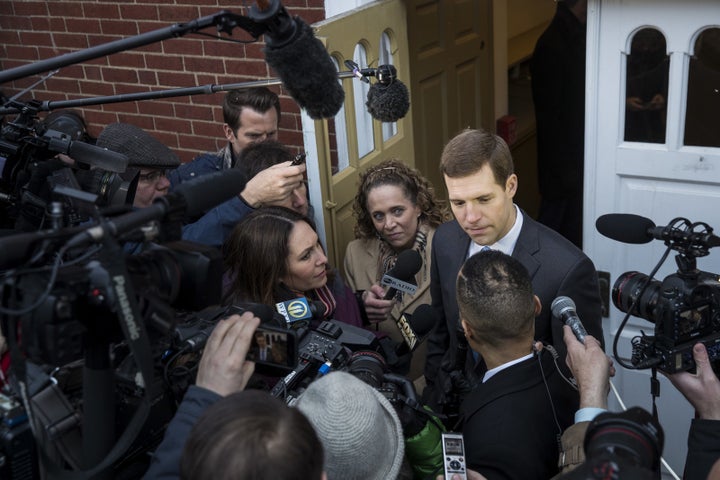
Suburban Pittsburgh voters will soon decide whether Democrat Conor Lamb or Republican Rick Saccone will fill the congressional seat vacated by a Republican who resigned amid a sex scandal.

Polling has shown a tight race, with Lamb running as a pro-Second Amendment critic of Minority Leader Nancy Pelosi, supported heavily by trade unions, in what is a Republican district.

"He's a God-fearing, union-supporting, gun-owning, job-protecting, pension-defending, Social-Security-believing, health-care-believing, sending-drug-dealers-to-jail Democrat," said Cecil Roberts, president of the United Mine Workers of America, who held a rally for Lamb in Waynesburg on Sunday afternoon.

Depending on who you ask or what you're asking about, this race is essentially meaningless or incredibly meaningful. Or both!

Essentially meaningless:

Because of all the Pennsylvania redistricting stuff playing out in court, this district is about to disappear. No matter who wins, they'll only be in this seat for nine months, and the outcome won't change the balance of the House of Representatives. (More than $12 million has been spent on this race.)

Incredibly meaningful:

If Lamb prevails (or even narrowly loses), that would indicate yet again that we're looking at a potential Democratic wave election in the fall. This a Republican district, and one where Trump remains more popular than he is in lots of places, so a win here is the kind of sign that Democrats would want to see.

How to watch the results:

At the moment, the 18th District contains slices of four counties — Allegheny, Greene, Washington, and Westmoreland — in suburban Pittsburgh.

First, Lamb will need to win the Allegheny County portion of the district outright. If he’s not winning there, he’s probably not going to win.

Dave Wasserman of the Cook Political Report put it even higher for a Lamb victory:

Second, take a look at how the ancestrally Democratic regions break. Though this district's been considered solidly Republican in recent years, there are parts that aren't or didn't used to be. Greene County, for instance, voted for Gov. Tom Wolf, a Democrat, in 2014, and for John Kerry in the 2004 presidential election.

Those are the kinds of areas people will be watching to divine results this fall.

Third, will the sharp break between areas dominated by white people with college degrees and those dominated by white people without college degrees continue in PA-18? (This kind of split can be seen in townships in Westmoreland and Allegheny, per Decision Desk HQ head Brandon Finnigan.)

That split (or lack of split) could be enormously important for the results in the fall; Democrats are largely looking to pick up seats in affluent suburban areas in states like Florida, California, and Virginia that often vote Republican but don't love President Trump. PA-18 is a good place to watch that split, as 37% of adults there have a college degree.

Alexis Levinson contributed reporting.

LINK: Is This Anti-Pelosi, Pro-Gun Pennsylvania Democrat Showing His Party The Way To Win Back Trump Voters?

LINK: Republicans Are Worried They’re About To Lose A House Seat, But Donald Trump Jr. Is Having A Blast


Source BuzzFeed - Politics http://ift.tt/2Gpw7UD

Wednesday, March 7, 2018

A Federal Court Just Rejected A Funeral Home’s Religious Objections To Employing A Transgender Woman

Mark Lennihan / AP

A federal appeals court on Wednesday ruled that a Michigan funeral home broke federal law when it fired a transgender woman, while tossing out the employer's claim that a religious objection created a legal loophole to terminate her.

The decision builds on a tide of federal court rulings that have found workers are protected from anti-LGBT discrimination, even though there is no federal law explicitly barring discrimination on the basis of sexual orientation or gender identity.

It is the first time in such a case that a federal appellate court considered an employer’s claim for a religious recusal under the Religious Freedom Restoration Act, a 1993 federal law known as RFRA — siding here with the transgender worker.

In ruling for Aimee Stephens and the Equal Employment Opportunity Commission, a federal agency that brought the case, the US Court of Appeals for the 6th Circuit found anti-transgender discrimination is prohibited by Title VII of the Civil Rights Act of 1964, which bans discrimination on the basis of sex, and that employing a transgender person posed no substantial burden on the employer’s religious exercise.

"Discrimination against employees, either because of their failure to conform to sex stereotypes or their transgender and transitioning status, is illegal under Title VII," said a 49-page opinion led by Judge Karen Nelson Moore.

"RFRA provides the Funeral Home with no relief because continuing to employ Stephens would not, as a matter of law, substantially burden Rost’s religious exercise."

Stephens had presented as a man when she started for the company in 2007, working her way up to funeral director at R.G. & G.R. Harris Funeral Homes, Inc. However, six years later, after Stephens announced plans to transition to a woman, the owner, Thomas Rost, fired her.

"The unrefuted facts show that the Funeral Home fired Stephens because she refused to abide by her employer’s stereotypical conception of her sex," the opinion continues. "RFRA provides the Funeral Home with no relief because continuing to employ Stephens would not, as a matter of law, substantially burden Rost’s religious exercise, and even if it did, the EEOC has shown that enforcing Title VII here is the least restrictive means of furthering its compelling interest in combating and eradicating sex discrimination."

The funeral home had claimed allowing Stephens to work while she dressed and represented herself as a woman would be an unjustified substantial burden upon the owner’s sincerely held religious beliefs. But the court noted, “The Funeral Home itself, however, is not affiliated with a church; it does not claim to have a religious purpose in its articles of incorporation; it is open every day, including Christian holidays; and it serves clients of all faiths.”

The court reversed a lower district court decisions, which had ruled in the funeral home’s favor, and sent the case back to reconsider the arguments in light of the appellate court’s reading of the laws.

The Alliance Defending Freedom, a conservative Christian legal group representing the funeral home, and EEOC did not immediately respond to requests for comment.


Source BuzzFeed - Politics http://ift.tt/2oVjuYY

The Justice Department Is Suing California Over Its Sanctuary Laws

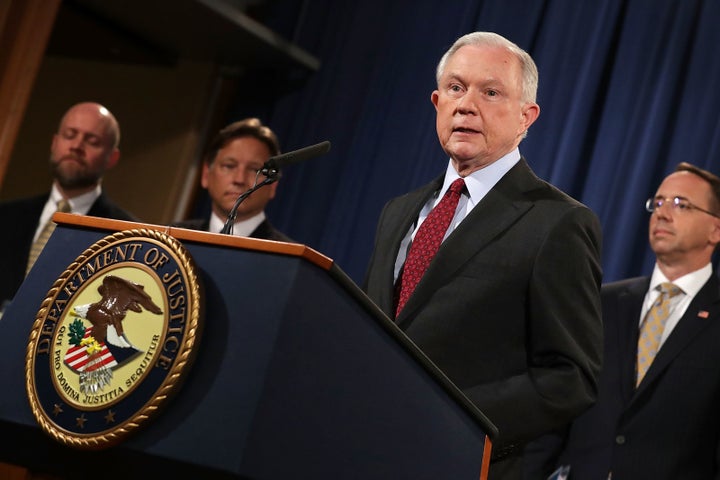
Attorney General Jeff Sessions

Joshua Roberts / Reuters

The Justice Department filed a constitutional challenge to California’s so-called sanctuary laws on Tuesday night.

The lawsuit represents an aggressive new push by Attorney General Jeff Sessions to go after "sanctuary jurisdictions," which have earned the immigration hardliner’s ire for adopting laws aimed at protecting undocumented immigrants and making it harder for federal immigration agents to find and deport them.

The lawsuit was filed in the US District Court for the Eastern District of California in Sacramento, and names the state and its Democratic governor and attorney general as defendants. Sessions is traveling on Wednesday to Sacramento to announce the lawsuit, a speech that was publicly billed as a “major sanctuary jurisdiction announcement" before the department filed in court.

The lawsuit accuses the state of violating the Supremacy Clause of the US Constitution. The Supremacy Clause, broadly speaking, dictates that when state law conflicts with federal law, federal law prevails. The Justice Department is arguing that the California laws at issue conflict with federal immigration laws and frustrate Congress’s goals in adopting them.

“The Department of Justice and the Trump administration are going to fight these unjust, unfair, and unconstitutional policies that have been imposed on you,” Sessions is expected to say in his prepared remarks Wednesday to law enforcement officers. “We are fighting to make your jobs safer and to help you reduce crime in America.”

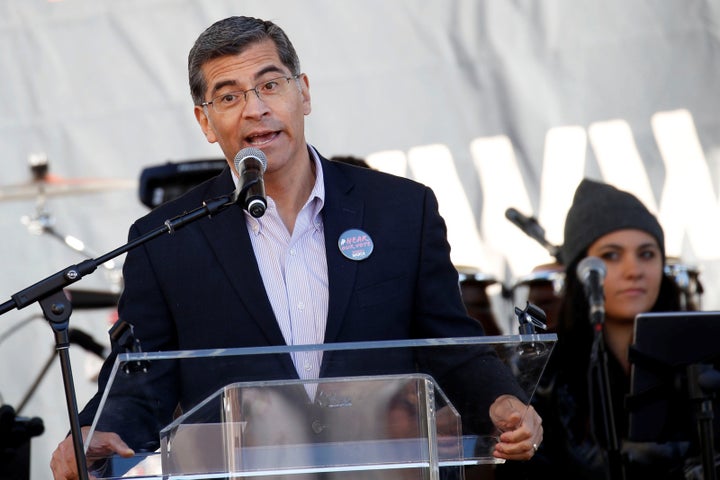
California Attorney General Xavier Becerra shot back Tuesday night — before he'd seen the lawsuit — insisting his state complies with federal law and comparing the Trump administration's announcement to a low-budget film.

"We have seen this B-rated movie before," Becerra said on a conference call with reporters, referring to the federal government's repeated clashes with California over immigration.

"They better have good evidence, because we are going to fight back," he said. "We are doing nothing to intrude on the work of the federal government to do immigration enforcement."

The Justice Department under Sessions already has taken steps to penalize state and local governments for adopting sanctuary laws, but this is the most direct challenge to date. Sessions has publicly and repeatedly criticized politicians and law enforcement officials who embraced these types of policies, and the Justice Department has been reviewing whether jurisdictions with sanctuary policies should lose their eligibility for federal grants.

Asked if more lawsuits like the one against California were coming against other states and cities with sanctuary laws, a senior Justice Department official said the department was in the process of reviewing immigration laws in other jurisdictions.

The lawsuit will challenge sections of three California laws: AB 450, signed by Gov. Jerry Brown in October, which restricts employers from cooperating with federal immigration officials; SB 54, also signed in October, which bars state and local law enforcement from alerting federal agents when an undocumented immigrants will be released from state custody and places restrictions on detainee transfers; and AB 103, signed in June, which requires the state’s attorney general to review state, local, and private detention facilities that house detainees on behalf of the Department of Homeland Security, as well as the circumstances of their detention.

“These are uncertain times for undocumented Californians and their families, and this bill strikes a balance that will protect public safety, while bringing a measure of comfort to those families who are now living in fear every day,” Brown said in a statement when he signed SB 54 into law.

Before the lawsuit had even been publicly announced, the state's governor criticized Sessions' planned Wednesday visit to the state, tweeting that Sessions was headed to the state "to further divide and polarize America." The governor's office later sent out Brown's tweet in response to news of the lawsuit.

The Justice Department is arguing that these laws are preempted by federal law in different ways. On AB 450, for instance, DOJ says that the law places requirements on employers to notify employees about a possible federal workplace inspection, even though federal laws don’t have any such requirement. The law also prohibits employers from giving federal immigration agents employee records without a subpoena or a warrant, or access to nonpublic areas without a warrant or other permission under federal law.

On SB 54, the government argues that the state’s prohibition on telling federal agents about a detainee’s release date — at which point federal officers could take them into custody — directly conflicts with federal immigration law; the law includes a few exceptions, but the Justice Department says those don't square with federal law either. A senior DOJ official said that a section of federal law that prohibits blocking a federal, state, or local officer from sharing information with federal immigration officials about “immigration status” applied to a detainee’s release date.

The Justice Department argues that by barring the transfer of detained immigrants to the US Department of Homeland Security, California is forcing agents to make arrests in the field, which is more dangerous for the agents and the public.

The Justice Department cited a US Supreme Court decision from 2012, United States v. Arizona, in which the court found that some, but not all, sections of an Arizona law aimed at boosting immigration enforcement were invalid because they conflicted with federal law, a senior official said. The justices found that the portions of Arizona’s law that dealt with immigrant registration, employment restrictions, and the grounds for making warrantless arrests based on immigration status all conflicted with federal law, and, as a result, were invalid.

The justices upheld a section of the Arizona law that required state law enforcement officers to make a “reasonable attempt” to verify the immigration status of a person they’ve stopped if there is “reasonable suspicion” that the person is unlawfully in the country. Justice Anthony Kennedy wrote for the majority that “Congress has done nothing to suggest it is inappropriate to communicate with ICE in these situations, however. Indeed, it has encouraged the sharing of information about possible immigration violations.”

Becerra, citing the state laws that the Justice Department alleges are superseded by federal policy, said, "I don't see the conflict, at least in terms of our laws." Asked about the Arizona immigration law partly struck down in 2012, he added, "We are following the Constitution and federal law."

An unsurprising defendant
An unsurprising defendant

California Attorney General Xavier Becerra

Patrick T. Fallon / Reuters

The Trump administration's lawsuit on Tuesday is its loudest bark yet at a sanctuary jurisdiction — and unsurprisingly, it’s aimed at California.

Politicians in the Democratically controlled state, which has an immigrant population in the millions, have repeatedly clashed with the administration over the issue.

Becerra has frequently led the charge or joined other Democratic attorneys general in suing the Trump administration over the past year, including challenges to the wind down of the Deferred Action for Childhood Arrivals (DACA) program, the construction of a border wall, the rollback of environmental regulations, and the reversal of Obama-era health care policies.

The administration, meanwhile, has attempted to coerce states into carrying out a hardline immigration agenda by threatening to deny federal grants. Sessions has argued jurisdictions that frustrate those aims are complicit in promoting violence.

Asked if California’s role as an antagonist played a part in deciding to sue the state now, a senior DOJ official said they were focused on fair enforcement of the law. The official did say that California’s laws were novel and went beyond what other states had done.

On Tuesday night, Becerra said he respects the federal government's jurisdiction on immigration, but he argued states have autonomy under the 10th Amendment to enact public safety laws as they see fit.

Policies that build bridges with immigrant communities encourage cooperation with police, he said. "We are in the business of public safety, not deportation."

He added that the Trump administration has threatened states and cities on immigration issues for the past year, and — apparently in reference to cases such as the travel ban and rescinding DACA — courts blocked the administration. "We are doing pretty well on this count," he said. "The Trump administration has acted outside the law, and they are the ones who have not respected the rule of law."

Until Tuesday’s lawsuit, most of the immigration-related lawsuits over the past year have come from the other direction — with states or other parties suing the Trump administration.

Last April, US District Judge William Orrick in California blocked key sections of Trump’s executive order to starve sanctuary jurisdictions from federal money, saying the executive branch overstepped its bounds by grabbing purse strings reserved for Congress.

The same month, the Justice Department indicated it would withhold law enforcement grants unless local agencies assisted with its federal immigration agenda — including by notifying federal agents when an undocumented immigrant was in local custody.

But a federal judge in Philadelphia blocked those conditions locally, while a federal judge in Chicago suspended most of those stipulations on the grants nationwide.

The Justice Department has been unrelenting in its threats, though, demanding that local officials show compliance with federal immigration law — Section 1373, the same section cited in the department’s new case against California — in order to receive funding from the so-called JAG program. The legal questions at play in the grant-related litigation and the latest action against California are different, however.

Responding to the Justice Department’s prior threats, a number of agencies, including the California Board of State and Community Corrections (BSCC), have insisted they are complying.

“The US Department of Justice has not provided any evidence that the BSCC, or any state recipient of JAG funds, is not in compliance with Section 1373,” a lawyer for the BSCC told the Justice Department in a letter last month.

State officials had asked courts to block the grant conditions entirely — but Orrick said in an order issued Monday that it would be premature to suspend the conditions now. Still, he wrote that the underlying legal questions remain unanswered, particularly because it’s not clear what it means to share information “regarding immigration status.”


Source BuzzFeed - Politics http://ift.tt/2Fsm2bD
Tuesday, March 6, 2018

The West Virginia Teachers Strike Is Shaping Up To Be A New Model For The Left

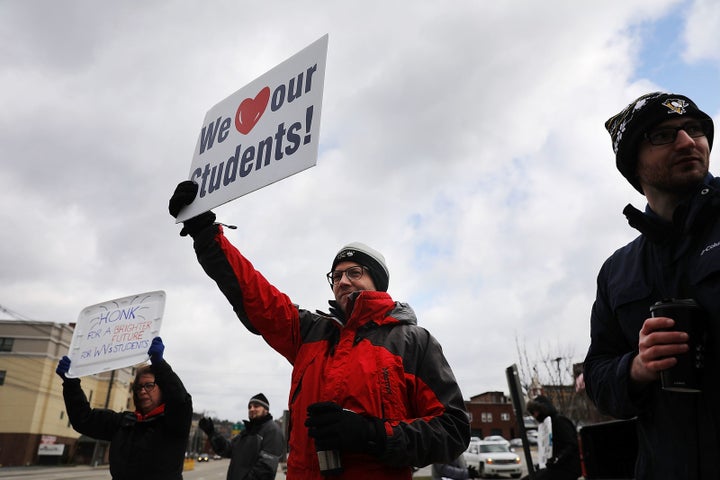
Spencer Platt / Getty Images

Their strike is illegal. It’s led by women. And it’s taking place in a state that the national Democratic Party has all but totally written off.

The teachers strike in West Virginia — in which thousands of workers have shuttered every public school in the state for more than a week — is offering a new model for the American left in a political era that has scrambled the old rules.

West Virginia went 68% for Trump in 2016. Bernie Sanders won every county in the Democratic primary. Now, teachers in the state, which is home to old American labor battlegrounds like “Bloody” Mingo County, have been striking over low pay and increasing healthcare costs.

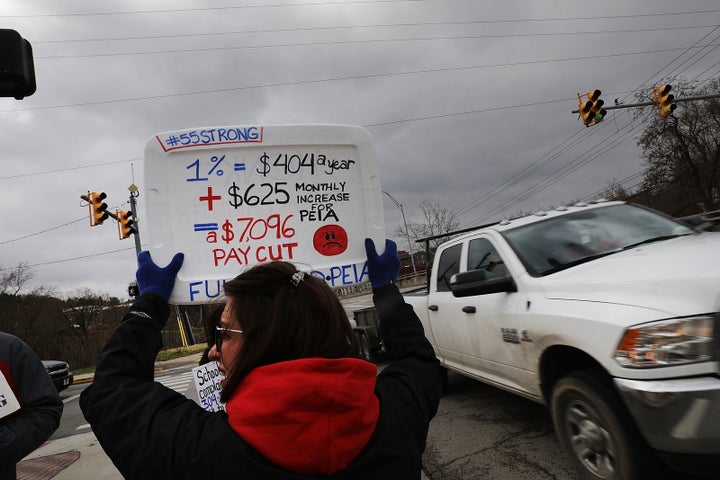
The workforce shows no signs of returning to work until their demands are met, including a 5 raise and plan to reform the underfunded state healthcare system. In 2016, West Virginia’s average teacher salary was $45,622, more than 20 below the national average. Meanwhile, premiums have gone up for everything from insulin to doctor’s visits, teachers say, and their plans, administered by the Public Employee Insurance Agency (PEIA), now cover fewer conditions.

On Feb. 27, Gov. Jim Justice and union leaders negotiated a deal that would have had the state employees return to work on March 1 — but, in a twist, the state Senate refused to vote on the legislation that would implement the agreed-upon 5% raise. Instead, senators argued for a 4% raise and sent an amended version of the bill back to the state house of delegates.

Jenna Prudich, 25, who teaches second grade, called it a “circus.”

Matt Adkins, a 38-year-old elementary school gym teacher from the city of Huntington, which received national attention in the Oscar-nominated documentary Heroin(e) for its high rates of opioid addiction, said he wished he could “blow his whistle” on the legislators and make them “walk back into the chamber to do it over again."

Other teachers told BuzzFeed News they’re worried lawmakers are stalling until the legislative session ends on Friday, which would nullify the proposed bill.

“Nobody trusts the government in West Virginia, period,” Adkins said. “We said we wouldn’t go back to work until they sign the bill, and they never signed it.“

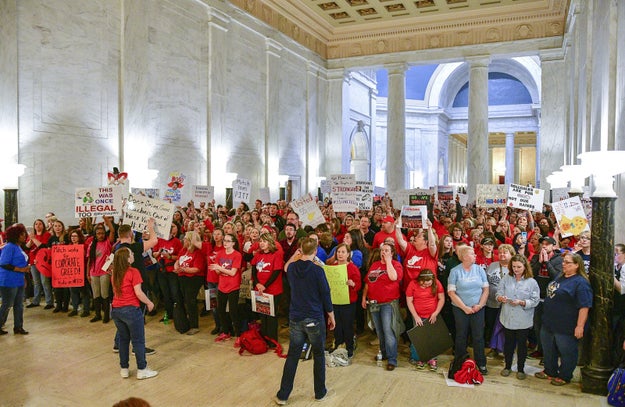
Teachers hold a rally outside the Senate Chambers in the West Virginia Capitol, March. 5, 2018 in Charleston, W.V.

Tyler Evert / AP

Adam Culver, who teaches seventh-graders language arts at Huntington Middle School, said he made just over $40,000 this year, his 11th teaching.

“When they first announced everything, there was nothing in writing, just promises,” Culver said of the proposed deal.

During the first days of the strike, Culver had worn a banana suit to the rallies to draw light-hearted attention to the cause, he said. But he went back that day dressed in all black, with a big sign over his head reading, "Bullshit."

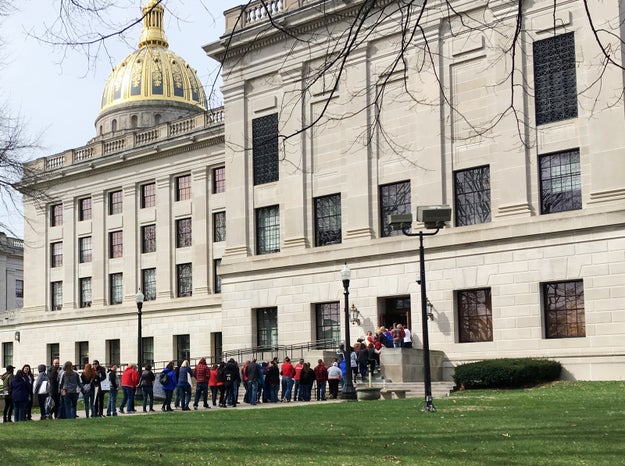
Monday, the lines to get into the capitol building in Charleston swelled to the largest since the protest began, teachers said, with thousands showing up in red shirts and bandanas, holding signs reading “#55strong” for all 55 closed school districts, and singing “Country Roads,” with lyrics that begin, “Almost heaven, West Virginia.”

The crowds Monday prompted a warning from police and the fire marshal that the capitol could exceed capacity.

Workers interviewed by BuzzFeed News say the strike is now about more than specific contract demands. It’s a testament to wide-ranging frustration over how state legislators under-value and under-invest in the public school system.

Ami Lester, a 36-year-old who has been teaching in West Virginia for 14 years as a reading specialist in a small community elementary school, said teachers had already succeeded in killing recent bills that pertained to seniority, charter schools, and school vouchers through organizing.

“Two things are happening here,” Adkins said of the ongoing action. “One is the people — the grassroots of West Virginia — fighting its government.”

The other, he continued, is old-fashioned “party politics,” which teachers now say reflect poorly on the Republican state senate leadership holding up the bill with their promised raise.

Monday afternoon, occupying the capitol building, teachers chanted cheers tailored to state Senate President Mitch Carmichael, including, “Mitch Better Have My Money,” a play on the Rihanna song.

When the politician emerged in the afternoon to urge the crowd to accept the 4 percent raise instead, teachers responded with a resounding, “Move, Mitch, get out the way. Get out the way, Mitch, get out the way.”

Spencer Platt / Getty Images

Several teachers said they were prepared to strike indefinitely, with some expressing a desire to ask for more when they heard teachers in Oklahoma are now asking for a $10,000 across-the-board raise. As it stands, a 5% raise for most teachers in West Virginia amounts to just a few thousand dollars.

Don Scalise, 39, who makes $45,000 teaching students Advanced Placement US Government and Politics at Cabell Midland High School, said lawmakers should be keeping an eye on their polling numbers.

"There are a number of people in the state senate who are up for reelection, and a lot of their constituents are teachers and parents," he said.

Notably, the workers' battle has raged on despite the fact that West Virginia law does not technically permit public employees to collectively bargain or strike.

The Supreme Court is also likely to decide this summer in the case Janus vs. the American Federation of State, County, and Municipal Employees. Should the court find that it’s unconstitutional to require public employees to pay fees to the unions that represent them, unions will likely take a colossal hit to their coffers and membership.

But the teachers in West Virginia — and now Oklahoma and Kentucky — are demonstrating that workers can organize and take action even in states where such strikes are illegal, and wield leverage over a state employer the old-fashioned way.

Striking West Virginia teachers line up to enter the state Capitol on March 5, 2018, in Charleston, W.Va.

John Raby / AP

Scalise said Monday that he sees the teachers' strike as the first front in a broader labor struggle, with eyes on nearby states. Teachers in West Virginia told BuzzFeed News that they’re now speaking with teachers in Kentucky about striking over unsatisfactory pension and retirement fund negotiations.

And in the past few days, nearly 40,000 people have joined a Facebook group — ”Oklahoma Teachers United” — that has pledged to strike on April 2 if teachers don’t receive a $10,000 increase to bring their salaries to a livable floor. In 2016, Oklahoma’s average teacher salary was $42,460, according to the Bureau of Labor Statistics.

As the action continues, West Virginia teachers have pledged to keep providing lunches and meals to students despite schools being closed, coordinating with superintendents to make sure backpacks of food are available to students who relied on them. One in four children in the state lives in poverty and experiences hunger, the highest rate in the country.


Source BuzzFeed - Politics http://ift.tt/2H7EdQT

Monday, March 5, 2018

Former Trump Adviser Says "Screw" Mueller Subpoena In Intense TV Interviews

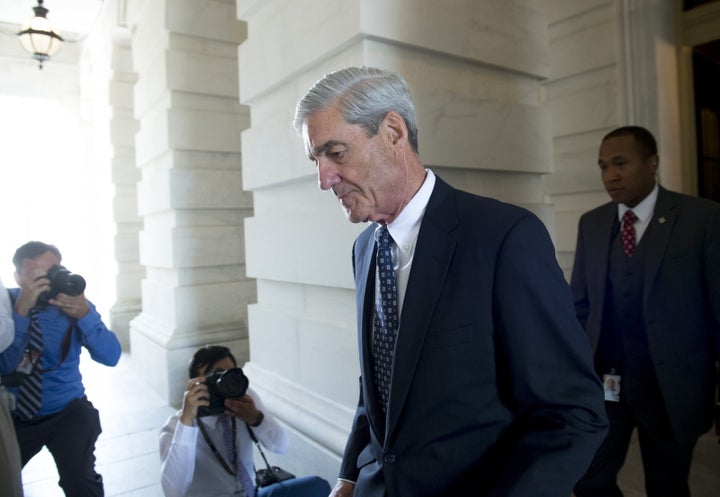
Robert Mueller

Afp Contributor / AFP / Getty Images

Sam Nunberg, a former Trump aide, said on Monday that he will refuse to comply with a subpoena issued by the federal grand jury convened by special counsel Robert Mueller III.

In back-to-back-to-back live, televised phone interviews with MSNBC and CNN on Monday afternoon, Nunberg called the demands for his emails and for him to testify before the grand jury "ridiculous."

Nunberg was fired from Trump's campaign in August 2015 after racist Facebook messages that he allegedly wrote surfaced. Nunberg told media outlets on Monday that he had been subpoenaed to provide documents to the grand jury and to appear in Washington, DC, on March 9 to testify before the grand jury.

"Screw that," he told Gloria Borger on CNN. He later appeared on CNN a second time to talk with Jake Tapper.

Under federal court rules in criminal cases, a person who fails to obey a grand jury subpoena "without adequate excuse" can be held in contempt of court. Asked if he was worried about that, Nunberg told Katy Tur on MSNBC, "Let's see what Mr. Mueller does."

"I think it would be funny if they arrested me," he said.

A spokesman for the special counsel's office declined to comment on Nunberg's comments. Nunberg did not immediately return a request for comment by BuzzFeed News.

Asked by Tur if he thought the special counsel's office had "something on the president," Nunberg replied, "I think they may."

"I think he may have done something during the election. But I don't know that for sure," Nunberg said. Asked to elaborate, he said, "I can't explain it unless you were in there."

Nunberg called the grand jury's requests for his emails with campaign and past and present White House officials — including former White House counselor Steve Bannon, former Trump campaign manager Corey Lewandowksi, former Trump campaign adviser Roger Stone, and outgoing White House communications director Hope Hicks — "ridiculous."

He said he was "not a fan" of Trump — Trump "screwed" him and Stone over during the campaign, he said — but after going over the grand jury subpoena, he agreed with Trump's assessment that the investigation was a "witch hunt."

"Why do I have to spend 80 hours going over my e-mails? That I've had with Steve Bannon and with Roger Stone? Why does Bob Mueller need to see my e-mails when I send Roger and Steve clips and we talk about how much we hate people?" Nunberg said.

Nunberg said on MSNBC that he decided "a couple hours ago," as he was going through his emails, not to comply with the subpoena. He told CNN's Bolger that he had started going through his emails over the weekend, and that he was supposed to turn them in on Monday afternoon. He said he had not been contacted about the subpoena by the White House, Trump, any member of Trump's legal team, Roger Stone, or Steve Bannon.

At another point in the interview with MSNBC, however, Nunberg said he hadn't gone over his emails since he was contacted by the special counsel's office. He didn't say when he received the subpoena.

Last month, multiple news outlets reported that Nunberg would sit down with the special counsel's office. On CNN on Monday afternoon, he confirmed that he had sat down with Mueller's office, calling them "very professional." On MSNBC, Tur asked Nunberg about the fact that last week he had said the Russia investigation was not a waste of time. He replied that receiving the subpoena had changed his mind.

Nunberg said he thought that his lawyer "is going to dump" him. Nunberg's attorney Patrick Brackley did not immediately return a request for comment.

Nunberg said special counsel's office investigators had asked if he heard people speaking Russian around Trump Tower and if he ever heard about efforts by the Trump Organization to develop a property in Moscow. In another interview on CNN, he said he'd never heard Russian spoken around Trump Tower.

"Donald Trump did not collude with the Russians! It is the biggest joke, to ever think Donald Trump colluded with the Russians," Nunberg said.

He told CNN that investigators wanted him to say that Roger Stone was telling people that he was colluding with Julian Assange, the founder of WikiLeaks. Nunberg said that did not happen.

In a statement to CNN, Stone said, "I was briefly part of the Trump campaign and have been the President's friend and adviser for decades; and would expect that Mueller's team would at some point ask for any documents or emails sent or written by me. But let me reiterate, I have no knowledge or involvement in Russian Collusion or any other inappropriate." A lawyer for Stone referred BuzzFeed News to the statement posted by CNN.

Nunberg has a reputation for bold pronouncements and occasional fictions. “Mueller is going to go over every financial dealing of Jared Kushner and the Trump Organization,” he told Vanity Fair after Mueller’s team indicted former Trump campaign chairman Paul Manafort. He said on MSNBC last month that he is “sure” Donald Trump, Jr. told his father about what happened during a meeting with Kremlin-connected officials, something the White House has denied. Just last week, he suggested to BuzzFeed News that Trump's re-election campaign is no sure thing.

And last November, he admitted to Politico that he was the source of an anecdote in a The New Yorker story about former New Jersey governor Chris Christie fetching Trump McDonald’s. Nunberg told Politico he’d made up the story to dig at Christie. The New Yorker subsequently said he was not the source.

Matt Berman and Chris Geidner contributed to this report. This is a developing story. Check back for updates.


Source BuzzFeed - Politics http://ift.tt/2I6HwJE

Sunday, March 4, 2018

All The Democratic Party’s Biggest Names Are Lining Up Against The Banks

Tasos Katopodis / Getty Images

Democratic presidential hopefuls are scrambling to come out against the first big bipartisan legislation of the Trump era, positioning themselves as hardliners on Wall Street regulation and free from the influence of banks.

It’s a sign that on a national political scale, many Democrats are betting there will no longer be any room with voters for nuance on the issue of Wall Street — or any appetite for bipartisanship. Ahead of a potentially bruising Democratic primary, some of the country’s top Democrats are apparently hoping to shed any perception that they are cozy with Wall Street donors.

A dozen moderate Democrats from red and purple states are using the Economic Growth, Regulatory Relief, and Consumer Protection Act — which rolls back some Dodd-Frank regulations for small- and medium-sized banks — as a chance to burnish their bipartisan credentials. Eleven have signed on to cosponsor what is expected, after a vote this week, to be the Senate’s first major bipartisan bill in more than two years.

But virtually all of the Senate’s most high-profile Democratic politicians have taken the opposite route, sharply criticizing the bill and saying they’ll vote against it. That includes past recipients of large sums of Wall Street money, like Kamala Harris, and people who’ve received that kind of money and been seen as more friendly to the banking industry, like Kirsten Gillibrand and Cory Booker. (While Harris has been criticized by some progressive Democrats for parts of her record as California's attorney general, in the wake of the mortgage crisis, she split with other states to broker her own settlements with big banks, winning a substantial sum, and special penalties, for California — the kind of aggressive action the party is trending toward.)

Booker, who is from New Jersey, has made headlines in the past for raking in money from Wall Street, and is still struggling to live down a comment he made in 2012 defending the hedge fund Bain Capital against Barack Obama. He labeled Obama’s criticism of Bain “nauseating to the American public” and called for the president to “stop attacking private equity.”

"The smart, ambitious and relatively young members of the Senate Democratic caucus are very aware that the politics of Wall Street and banks in general have radically changed"

In a statement to BuzzFeed News, Booker called the new Senate banking bill “plainly unacceptable,” saying Congress should be “strengthening, not weakening, the safeguards put in place of a greed and excess-fueled financial crisis that brought hundreds of billions of dollars of big bank bailouts.

“The smart, ambitious and relatively young members of the Senate Democratic caucus are very aware that the politics of Wall Street and banks in general have radically changed,” said Jeff Hauser, of the Center for Economic and Policy Research, a left-leaning think tank. “If you plan to be around for a while — particularly if you plan to run for president — you want to be opposed to this bill.”

With 11 Democrats behind it, the bill is likely to sail through the Senate. But the chorus of opposition from so many prominent Democrats and left-wing groups points to a shift in the Democratic Party, said Warren, who has long been one of the party’s loudest voices for Wall Street regulation.

“More and more, elected Democrats are standing up for working people — even when it means their Wall Street friends are unhappy,” she told BuzzFeed News in a phone interview. “The real energy of the Democratic Party is in the grassroots.”

“We were out alone on this issue for decades,” said one senior Democratic aide. “Now you have these big names signing on with us.”

In the past, part of Democrats’ reluctance to hit the financial industry hard has had practical roots; many have relied both on large individual checks from wealthy bankers and counting on them to act as “bundlers,” rallying friends to cut checks themselves.

But high-profile Democrats like Sanders and Warren, and increasingly people like Harris and Gillibrand, can more easily take in small-dollar donations from supporters with sprawling email lists.

Banks have also stopped spreading their money as liberally among both parties.

“I don’t think the math works anymore,” said Hauser. “If I were banks, I would consider radically increasing money to make it tougher for Democrats to come out against things like this, because right now, the politics and the policy are totally aligned. Banks don’t have enough to offer Democrats.”

Perhaps even more than Booker, whose Senate voting record has often gone against financial industry interests, Gillibrand has been seen previously as friendly to Wall Street, and has spent time courting — and catering to — major financial industry donors. Last month, though, Gillibrand announced she would stop taking money from corporate PACs, joining more left-wing senators like Elizabeth Warren and Bernie Sanders. Booker followed suit hours later.

Whether the bill, steered by Idaho Republican Mike Crapo, is a much-needed lifeline to community banks battered by regulation or a massive giveaway to some of the country’s biggest financial institutions depends on which Democrat you ask.

While the Dodd-Frank Act, passed in the wake of the 2008 financial crisis, exempted only banks with assets less than $50 billion from its rules, the new bill would raise that limit to $250 billion — an umbrella which would provide relief to community banks but would also include larger financial institutions, like BB&T and American Express.

Tim Kaine, a purple-state Democrat who has added his name to the bill, supports the bill because it “provides relief for small community banks and credit unions in Virginia,” a spokesperson told BuzzFeed News, “while strengthening consumer protections for all Americans and maintaining critical Dodd-Frank reforms.”

Crapo’s bill is significantly more moderate than a House version, which would essentially rewrite the Dodd-Frank bill passed in the wake of the 2008 financial crisis.

It’s “not a major, substantive correction” to Dodd-Frank, said Justin Schardin, a fellow at the Bipartisan Policy Center, a centrist think tank. “There’s a lot of prominent Democrats — including Barney Frank — who support raising the limit” on the size of banks subject to regulations. The big issue, he said, is over what that limit should be.

The $250 billion cap in the new bill, Warren warned, means “that 30 or 40 of the largest banks in the country would be regulated like tiny community banks. This is nuts.” Had it been in place in 2008, it would, she said, have included Countrywide, a bank widely seen as one of the architects of the financial crisis.

Warren took her opposition to the bill a step farther than others in her party, surprising even some left-wing Democratic aides by explicitly taking aim at Democratic moderates.

Warren took her opposition to the bill a step farther than others in her party, surprising even some left-wing Democratic aides by explicitly taking aim at Democratic moderates. She rallied her supporters against them in an email last week, warning that “Republicans AND Democrats are gutting the rules on Wall Street.”

“The bank lobbyists have been hitting Capitol Hill hard, and they have a Dodd-Frank rollback bill lined up with the support of every Republican and twelve Democrats,” she told supporters.

Even as the gun-control debate rages across the country — and with the banking bill’s passage virtually assured — progressive groups have mobilized the Democratic base against it. Daily Action texted supporters on Wednesday urging them to call senators about the bill; Indivisible, a group that formed in the wake of Trump’s election, pushed out call scripts for members to urge senators to vote against the bill because it “puts us at risk of another financial crisis.”

The point is to “send a message,” said Chad Bolt, of Indivisible. “We just want Republicans and Democrats to know that there is a strong appetite in the country for regulating Wall Street.” The Democrats supporting the bill, Bolt said, “are out of step with what the majority of Americans believe.”

For many of the Democrats who have signed onto the banking bill, part of the allure is the opportunity to demonstrate bipartisanship in a gridlocked Senate, said Schardin. “It helps them electorally. They want to be practical, to get things done, and this is a way to show — we actually did something.”

The bill is apparently a tricky balance for some moderate Democrats who are considered potential candidates in 2020 but have, in the past, touted their bipartisan credentials. Chris Murphy, of Connecticut, and Amy Klobuchar, from Minnesota — which barely tilted to Clinton in the 2016 election — both wouldn’t say how they planned to vote on the banking bill this week, though the Senate’s version has been out since December.

It’s the bill’s timing, more than anything else, that might become ammunition against Democrats in future races.

“The national conversation at the moment is rightly focused on gun safety, but the Senate is taking up a totally unrelated bill to deregulate big banks,” said Bolt. “It’s totally out of touch.”


Source BuzzFeed - Politics http://ift.tt/2oHcqju

Thursday, March 1, 2018

As Trump Spirals, Many Of His Staffers Are Looking To Exit

Mandel Ngan / AFP / Getty Images

Even for this chaotic administration, the last few weeks have taken a toll on President Donald Trump and his staff. A tragic mass shooting, big-name staff departures, and a series of scandals — all in the growing shadow of the investigation into Russia’s involvement in 2016 election — has left the White House under a dark cloud of low morale and constant frustration.

Many mid- and low-level staffers are anxious to leave and are actively looking for jobs elsewhere, sources close to the White House say. Those staffers saw the surprising resignation of Trump loyalist and communications director Hope Hicks on Wednesday as a sort of tipping point.

A former White House official said he's spoken with more aides inside the White House who are trying to leave the administration, but not necessarily getting the kinds of high-paying offers in the corporate world as former aides usually do.

"Things are still pretty bleak inside the White House," the source said. "I've talked to several people in the last week trying to find a way out, but they can't get out because no one is really hiring people with Trump White House experience. Not a fun time to say the least."

Another source close to the administration said he has also talked to those on the inside about potential job offers. The source said he remembers seeing one particularly fitting pun about Hick's departure on Thursday: "The White House has lost Hope." "That about says it all, right?" the source added.

Meanwhile, Trump, with crises swirling around him, has been going rogue, taking positions that aren’t in line with the GOP and surprising his aides — more so than usual — with his comments on issues like trade and gun control.

This level of chaos, unusual even in the relative terms of the Trump presidency, is underlined by a staff exodus. Trump famously values loyalty to a supreme degree. And right now, Trump’s White House is bleeding loyalists, and those who are left are under deepening pressure.

Trump used an open-press meeting on guns with a bipartisan group of lawmakers on Wednesday to essentially buck long-standing Republican orthodoxy and the National Rifle Association while siding with Democrats about the legitimacy of more stringent gun control proposals. He went as far as to say: “Take the guns first, go through due process second.” And on Thursday, Trump announced he wanted new tariffs on steel and aluminum, again with cameras rolling and without fully informing his staff of the decision.

Members of Trump’s own party on Capitol Hill are still trying to figure out what to make of Trump’s recent comments, especially on guns.

"I don't know," said South Dakota Sen. John Thune, the No. 3 Republican in the Senate, when asked about narrowing the conversation after Trump broadened it at Wednesday’s meeting. “You saw it, right? It was wild. I just I think the president's going to have to narrow his list of issues that he would like to see addressed and figure out ... what's realistic."

There are any number of weeks or months from Trump’s first year in office that could reasonably be considered the most crisis-laden, but the last month is taking a real run at the crown.

The spiral began soon after Trump’s first State of the Union address, when Trump’s staff secretary, who helped prepare the president for that speech, was accused of serial domestic abuse by two of his ex-wives. The White House defended Porter, who had become of the staffers closest to Trump, before he ultimately resigned.

That scandal raised another serious problem for the White House, and undermined chief of staff John Kelly’s authority: Some in the White House apparently knew about the allegations against Porter months before they were revealed in the press, and still allowed Porter access to highly sensitive information.

The ensuing outcry over security clearances, and how dozens of White House staffers were able to operate under interim clearances while their background checks dragged on, quickly came to focus on Jared Kushner, Trump’s top adviser and son-in-law.

Kushner, who came to the White House with complicated business dealings and has reportedly been a subject of the special counsel’s investigation into Russia’s interference in 2016’s election, had his clearance downgraded under new rules laid out by Kelly, significantly limiting his once infinite purview. Trump’s family is said to be frustrated by Kelly’s role in sidelining Kushner, and the president himself has fumed over Kelly’s handling of the Porter episode.

Special Counsel Robert Mueller’s investigation hasn’t just recently impacted what information Kushner is able to access. The public results of that investigation — which is examining whether or not anyone from Trump’s campaign colluded with Russia or if the president himself has obstructed justice in the course of the investigation — have intensified in the last month, with indictments against over a dozen Russians and new charges in the cases against Trump’s former campaign chairman and his deputy. Even more troubling for Trump: that deputy, Rick Gates, flipped his plea to guilty, and is now working with investigators.

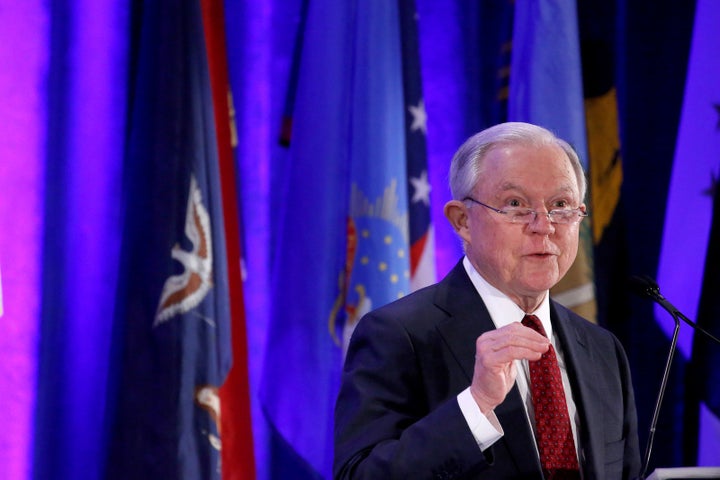
Mueller’s team is also now reportedly looking into Trump’s treatment of Attorney General Jeff Sessions last summer, and whether or not it constituted an attempt to remove him from office as a way of interfering with Mueller’s investigation. That report came to light this week just as Trump has renewed his pressure on Sessions. Sessions is now publicly defending himself, in an exceedingly rare and direct rebuttal to the president.

Kushner has had few public defenders in recent weeks, with some blaming Kelly for how the president’s son-in-law is being treated. Anthony Scaramucci, the short-lived former communications director, took jabs at Kelly, who fired him, on TV Thursday. The morale inside the White House, Scaramucci said on CNN, is “terrible. And the reason why the morale is terrible is the rule by fear and intimidation does not work in a civilian environment.”

Kelly, for his part, joked at a Department of Homeland Security event Thursday morning that his time in the White House isn’t exactly a delight.

“I miss every one of you, every day,” Kelly, who was previously the department’s secretary, said to laughs and applause, before rolling his eyes. “The last thing I wanted to do was walk away from one of the great honors of my life, being the secretary of Homeland Security, but I did something wrong and God punished me, I guess.”

Hicks, one of the last two remaining White House staffers who had been with Trump through his business and campaign, announced Wednesday her plan to leave her post as communications director. Her job title partially belies how important she has been to Trump, working closely with him through years of ups and downs. Those downs include Hicks’ reported role in devising a response to Donald Trump Jr.’s June 2016 meeting with with a Russian lawyer with Kremlin ties — a response that is now of particular interest to Mueller’s team. Hicks, who was also dating Porter at the time his alleged abuse was revealed, did not give a reason for her exit, but she had met privately with the House Intelligence Committee the day before.

Also leaving is Josh Raffel, a top adviser and communications official to Kushner and Ivanka Trump. The timing is tricky for Trump’s family: Even more than the reduced security clearance, Kushner is under increasing pressure with reports this week that he met, in his official capacity as a White House adviser, with executives who gave loans to his family’s company, and that multiple foreign nations have discussed ways of leveraging Kushner’s business interests for their own advantage.

Despite the increasing staff exodus, many Republicans remain hopeful that Trump will continue to sign their policy priorities and ignore the rest.

Georgia Sen. Johnny Isakson framed the departures as not out of the ordinary and “Washington as usual.”

"Somebody's always coming, and somebody's always going at the White House,” he said.

Lissandra Villa contributed reporting.


Source BuzzFeed - Politics http://ift.tt/2HSaUTz

Monday, February 26, 2018

Ivanka Trump Said It Was "Inappropriate" To Ask If She Believes Her Father's Accusers

Patrick Semansky / AFP / Getty Images

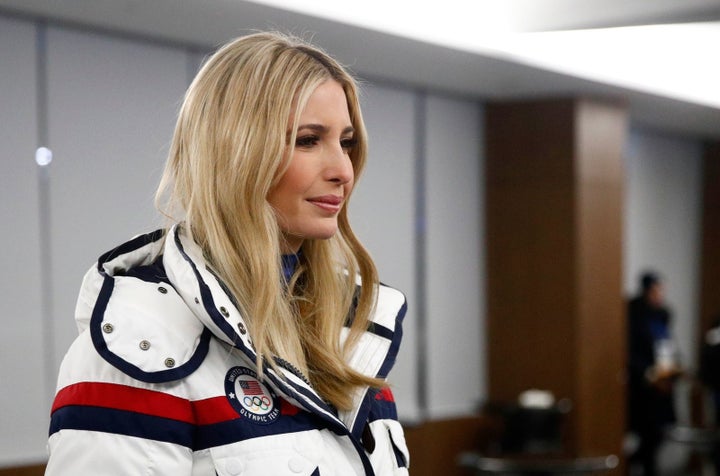
Asked whether she believes the women who have accused her father of sexual misconduct, Ivanka Trump said that she believes the question is "inappropriate" to ask a daughter about a father.

"I think it's an inappropriate question to ask a daughter, if she believes the accusers of her father, when he's affirmatively stated that there's no truth to it," she said in an interview with NBC News that aired Monday . "I don't think that's a question you would ask many other daughters."

Trump, speaking from Pyeongchang, repeated, "I believe my father. I know my father. So, I think I have that right, as a daughter, to believe my father."

At least 16 women have alleged the president sexually harassed them, with some calling for an investigation into his behavior comparable to the investigations launched after some members of congress were accused of sexual misconduct and abuse.

Trump has repeatedly defended her father in the past, stating she believes his denials. She has also said her priorities working in the White House include advocating for women, such as by working to increase paid parental leave.

Earlier in the interview, Trump had answered questions in her capacity as a senior White House adviser, rather than as a daughter — on her role during the Olympics, for example, working with South Korea to put pressure on North Korea.

Trump also stated that "there was no collusion" with Russia during her father's 2016 campaign and that the administration "believes that Mueller will do his work" as special counsel for the investigation into foreign interference. She said that she has not been interviewed by Mueller.

Trump concluded the interview in an official capacity as well, weighing in on education and job creation.

"We need to ensure that the skills being taught in our classrooms and the skills being taught to the American workers align with the jobs that are in demand in the modern economy," she said.

"Let’s Try Round Two": Three Women Who Accused Trump Of Sexual Misconduct Speak Out Again

Watching Harvey Weinstein Fall, Trump's Accusers Feel Frustrated


Source BuzzFeed - Politics http://ift.tt/2otXF3m

The New No. 3 Person At DOJ Is Only In The Role On A Temporary Basis. The Same Is True Of Many Offices He Oversees.

Chip Somodevilla / Getty Images

WASHINGTON — More than 13 months into the Trump administration, the Justice Department is now officially without its Senate-confirmed No. 3 in charge — a department where nine of the divisions or offices that reported to former Associate Attorney General Rachel Brand also lack a permanent leader.

Much attention over Brand’s departure has focused on the order of succession at the Justice Department — a recurring question given President Trump’s repeated lashing out at both Attorney General Sessions and Deputy Attorney General Rod Rosenstein, who oversees the special counsel’s Russia investigation.

Within the department itself, however, there is another issue that Brand leaving her job highlights: There are very few people serving in “permanent” roles in the Justice Department.

Brand — who oversaw a significant part of the Justice Department’s portfolio and had served in the Justice Department for several years of the George W. Bush administration — was confirmed by the Senate and seen as helping provide day-to-day stability in the department. With Brand out, Acting Associate Attorney General Jesse Panuccio, who joined the Justice Department for the first time a month into the Trump administration, has taken over her responsibilities for the time being.

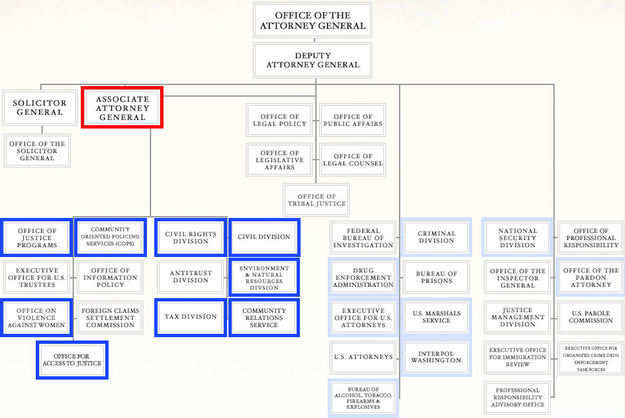
Four of the five legal divisions Brand oversaw lack their own Senate-confirmed leader, a multiplying effect on her departure, and one that is echoed in the the offices that reported to Brand as well. That includes the Tax Division, amid significant changes to the US tax code passed into law by the Republican Congress last year, and the Civil Division, responsible for representing the president and other federal officials in many lawsuits filed against the administration.

A Justice Department spokesperson declined to comment on the issue.

Former Justice Department officials tell BuzzFeed News say the situation isn’t a dramatic one legally. Strong acting heads, who are widely respected, sometimes still can have great influence, of course. And some components have not had a Senate-confirmed leader for several years, including the Civil Rights Division (2013) or the Office on Violence Against Women (2012).

But in a day-to-day interactions, people serving in acting roles understandably can have difficulties asserting themselves or their office’s priorities — particularly outside of their agency — in political and even policy discussions. And with fewer people in permanent roles, the Trump administration lacks the stability for good government, or for advancing an actual agenda, more than a year into the presidency.

This topic of vacancies at Justice is not new — NPR, the Washington Post, and Above the Law all wrote about the issue in the opening weeks of 2018, before Brand announced her departure. But Brand's departure adds a new importance to the wide breadth of vacancies in offices that reported to her.

For any administration, the first years are often the most productive in terms of advancing their agenda — and the continued slow pace of the Trump administration in filling roles with permanent leadership reflects the lack of a fully realized Trump administration and, in some cases here, an apparent disinterest in advancing some of the previously established functions of the department.

An acting assistant attorney general oversees the Civil Division, Civil Rights Division, and Environment and Natural Resources Division (ENRD) currently. The Tax Division is being helmed by the principal deputy assistant attorney general — a consequence of there not yet even being a nominee for the position.

There are pending nominations for the three legal divisions with "acting" heads, at various stages in the Senate process. Eric Dreiband, Trump’s nominee to run the Civil Rights Division, and Jeffrey Bossert Clark, Trump’s ENRD nominee, are two of the three Justice Department nominations awaiting floor action in the Senate — along with Criminal Division nominee Brian Benczkowski. Senate Majority Leader Mitch McConnell has not yet taken action to consider their nominations, however, focusing instead primarily on getting judicial nominees confirmed. Trump’s nominee to head the Civil Division, Jody Hunt, was only sent to the Senate initially in December after several months’ delay and, as a result, is much less far along: He is yet to receive a hearing in the Senate Judiciary Committee.

In all, of the legal divisions that reported to Brand, Assistant Attorney General Makan Delrahim, running the Antitrust Division, is the only Senate-confirmed legal division head in place.

BuzzFeed / Justice Department / Via justice.gov

Within the offices that report to the associate attorney general, the situation is more stark.

Trump has not even nominated leaders for the Community Relations Service, Office of Justice Programs, or Office on Violence Against Women. (Given that the department’s budget proposal would eliminate the Community Relations Service, it appears that a nominee is unlikely to be coming anytime soon for that office.) Additionally, and as reported by the New York Times, the new administration has effectively closed the Office for Access to Justice. The Community Oriented Policing Services, or COPS Office, currently has an acting director — even though the leadership of that office is appointed by the attorney general and so doesn’t have to go through the Senate confirmation process.

The only offices that report to the associate attorney general that have permanent heads are the Executive Office for the US Trustees and the Office of Information Policy — and they have been in their roles since the George W. Bush administration.

The final entity overseen by the associate attorney general is the Foreign Claims Settlement Commission. The two part-time commissioners serving currently were nominated by President Obama and both have been serving for several years now.


Source BuzzFeed - Politics http://ift.tt/2ESzdmH

Saturday, February 24, 2018

The Democrats Just Released Their Own Memo About The Russia Investigation. Read It Here.

Democrats released a redacted memo on Saturday that they say rebuts Republican claims that the Justice Department and FBI abused their spying powers in the Russia investigation.

The document, a direct counterpart to a Republican memo released early this month, was written by members of the House Intelligence Committee.

The release comes after President Donald Trump told Democrats they would have to redact the document before it could be made public, delaying it by two weeks.

Democrats argued that they needed to release their 10-page memo to clarify what Rep. Adam Schiff, the top Democrat on the House Intelligence Committee, called “many distortions and inaccuracies” in the Republican memo.

This is a developing story. Check back for updates or follow BuzzFeed News on Twitter.

Read the memo:


Source BuzzFeed - Politics http://ift.tt/2CGC4ZQ