Wednesday, January 31, 2018

A global heatmap from GPS-tracking company Strava that tracks people's exercise habits could pose security risks for military forces around the world.


Source CNN.com - RSS Channel - App Tech Section http://ift.tt/2FzWkyj

Digital artist Jan Frojdman spent three weeks shifting through 33,000 images obtained from NASA to create this 3D model of Mars.


Source CNN.com - RSS Channel - App Tech Section http://ift.tt/2FwT32A


Source CNN.com - RSS Channel - App Tech Section http://ift.tt/2Fuk6eX

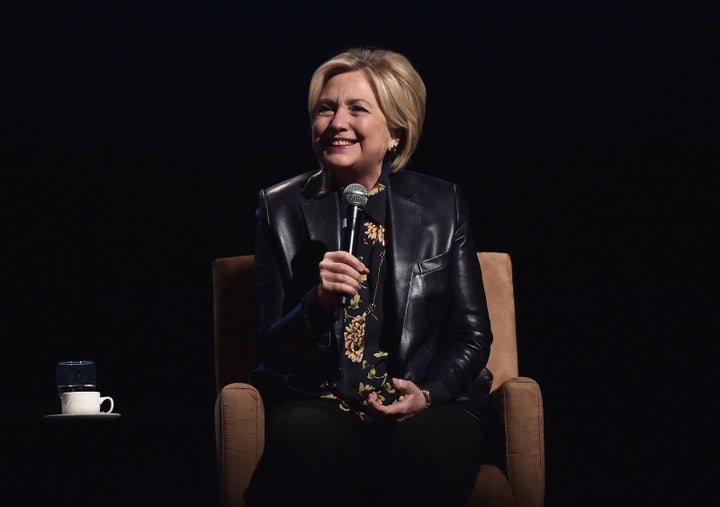
Hillary Clinton On Decision Not To Fire Adviser Accused Of Harassment: "If I Had It To Do Again, I Wouldn’t"

Alberto E. Rodriguez / Getty Images

On Tuesday night, Hillary Clinton said if she had to do over again, she would fire the former campaign adviser who was accused of sexual harassment on her 2008 campaign.

BuzzFeed News on Saturday reported that in 2007, a woman filed a complaint against her boss, the campaign's faith and values adviser, Burns Strider. The woman said that he was "touchy" and described "excessive tracking" of her whereabouts, among other complaints of harassment, according to documents obtained from the 2008 campaign. Some campaign officials — including the campaign manager — wanted to fire him, and Clinton was eventually briefed on the complaint, but decided against firing him, according to three campaign officials.

BuzzFeed News also reported on two additional young women who said that Strider behaved inappropriately toward them while they worked at a pro-Clinton super PAC ahead of Clinton's second campaign.

Of her decision not to fire Strider in 2007, Clinton wrote on Tuesday, "I didn’t think firing him was the best solution to the problem. He needed to be punished, change his behavior, and understand why his actions were wrong. The young woman needed to be able to thrive and feel safe. I thought both could happen without him losing his job. I believed the punishment was severe and the message to him unambiguous."

Clinton first addressed the issue on Friday night in two tweets, following a New York Times story about the 2008 campaign, saying she had called the woman who filed the original complaint to say “how proud I am of her and to make sure she knows what all women should: we deserve to be heard.” Of the 2007 events, Clinton wrote that she was “dismayed when it occurred, but was heartened the young woman came forward, was heard, and had her concerns taken seriously and addressed.”

In an interview on Saturday, Strider acknowledged many of the incidents described in the story as true; others he said he did not recall in the same way as the women interviewed. He apologized broadly for his behavior and noted that he has struggled with depression and is in therapy.

The full statement:

The most important work of my life has been to support and empower women. I’ve tried to do so here at home, around the world, and in the organizations I’ve run. I started in my twenties, and four decades later I’m nowhere near being done. I’m proud that it’s the work I’m most associated with, and it remains what I’m most dedicated to.

So I very much understand the question I’m being asked as to why I let an employee on my 2008 campaign keep his job despite his inappropriate workplace behavior.

The short answer is this: If I had it to do again, I wouldn’t.

Before giving some of the reasons why I made a different choice back then and why looking back I wish I’d done it differently, here’s what happened and what my thinking was at the time.

In 2007, a woman working on my campaign came forward with a complaint about her supervisor behaving inappropriately toward her. She and her complaint were taken seriously. Senior campaign staff and legal counsel spoke to both her and the offender. They determined that he had in fact engaged ininappropriate behavior. My then-campaign manager presented me with her findings. She recommended that he be fired. I asked for steps that could be taken short of termination. In the end, I decided to demote him, docking his pay; separate him from the woman; assign her to work directly for my then-deputy-campaign manager; put in place technical barriers to his emailing her; and require that he seek counseling. He would also be warned that any subsequent harassment of any kind toward anyone would result in immediate termination.

I did this because I didn’t think firing him was the best solution to the problem. He needed to be punished, change his behavior, and understand why his actions were wrong. The young woman needed to be able to thrive and feel safe. I thought both could happen without him losing his job. I believed the punishment was severe and the message to him unambiguous.

I also believe in second chances. I’ve been given second chances and I have given them to others. I want to continue to believe in them. But sometimes they’re squandered. In this case, while there were no further complaints against him for the duration of the campaign, several years after working for me he was terminated from another job for inappropriate behavior. That reoccurrence troubles me greatly, and it alone makes clear that the lesson I hoped he had learned while working for me went unheeded. Would he have done better – been better – if I had fired him? Would he have gotten that next job? There is no way I can go back 10 years and know the answers. But you can bet I’m asking myself these questions right now.

Over the years, I have made, directly and indirectly, thousands of personnel decisions – everything from hiring to promoting to disciplining to firing. Most of these decisions worked out well. But I’ve gotten some wrong: I’ve hired the wrong people for the wrong jobs; I’ve come down on people too hard at times. Through it all, I’ve always taken firing very seriously. Taking away someone’s livelihood is perhaps the most serious thing an employer can do. When faced with a situation like this, if I think it’s possible to avoid termination while still doing right by everyone involved, I am inclined in that direction. I do not put this forward as a virtue or a vice – just as a fact about how I view these matters.

When The New York Times reported on this incident last week, my first thought was for the young woman involved. So I reached out to her – most importantly, to see how she was doing, but also to help me reflect on my decision and its consequences. It’s never easy when something painful or personal like this surfaces, much less when it appears all over the news. I called her not knowing what I’d hear. Whatever she had to say, I wanted her to be able to say it, and say it to me.

She expressed appreciation that she worked on a campaign where she knew she could come forward without fear. She was glad that her accusations were taken seriously, that there was a clear process in place for dealing with harassment, and that it was followed. Most importantly, she told me that for the remainder of the campaign, she flourished in her new role. We talked about her career, policy issues related to the work she’s doing now, and her commitment to public service. I told her how grateful I was to her for working on my campaign and believing in me as a candidate. She’s read every word of this and has given me permission to share it.

It was reassuring to hear that she felt supported back then – and that all these years later, those feelings haven’t changed. That again left me glad that my campaign had in place a comprehensive process for dealing with complaints. The fact that the woman involved felt heard and supported reinforced my belief that the process worked – at least to a degree. At the time, I believed the punishment I imposed was severe and fit the offense. Indeed, while we are revisiting whether my decision from a decade ago was harsh enough, many employers would be well served to take actions at least as severe when confronted with problems now – including the very media outlet that broke this story. They recently opted to suspend and reinstate one of their journalists who exhibited similarly inappropriate behavior, rather than terminate him. A decade from now, that decision may not look as tough as it feels today. The norms around sexual harassment will likely have continued to change as swiftly and significantly in the years to come as they have over the years until now.

Over the past year, a seismic shift has occurred in the way we approach and respond to sexual harassment, both as a society and as individuals. This shift was long overdue. It occurred thanks to women across industries who stood up and spoke out, from Hollywood to sports to farm workers – to the very woman who worked for me.

For most of my life, harassment wasn’t something talked about or even acknowledged. More women than not experience it to some degree in their life, and until recently, the response was often to laugh it off or tough it out. That’s changing, and that’s a good thing. My own decision to write in my memoir about my experiences being sexually harassed and physically threatened early in my career – the first time was in college – was more agonizing than it should have been. I know that I’m one of the lucky ones, and what happened to me seemed so commonplace that I wondered if it was even worth sharing. But in the end, that’s exactly why I chose to write about it: because I don’t want this behavior or these attitudes to be accepted as “normal” for any woman, especially those just starting out in their lives.

No woman should have to endure harassment or assault – at work, at school, or anywhere. And men are now on notice that they will truly be held accountable for their actions. Especially now, we all need to be thinking about the complexities of sexual harassment, and be willing to challenge ourselves to reassess and question our own views.

In other words, everyone’s now on their second chance, both the offenders and the decision-makers. Let’s do our best to make the most of it.

We can’t go back, but we can certainly look back, informed by the present. We can acknowledge that even those of us who have spent much of our life thinking about gender issues and who have firsthand experiences of navigating a male-dominated industry or career may not always get it right.

I recognize that the situation on my 2008 campaign was unusual in that a woman complained to a woman who brought the issue to a woman who was the ultimate decision maker. There was no man in the chain of command. The boss was a woman. Does a woman have a responsibility to come down even harder on the perpetrator? I don’t know. But I do believe that a woman boss has an extra responsibility to look out for the women who work for her, and to better understand how issues like these can affect them.

I was inspired by my conversation with this young woman to express my own thinking on the matter. You may question why it’s taken me time to speak on this at length. The answer is simple: I’ve been grappling with this and thinking about how best to share my thoughts. I hope that my doing so will push others to keep having this conversation – to ask and try to answer the hard questions, not just in the abstract but in the real-life contexts of our roles as men, women, bosses, employees, advocates, and public officials. I hope that women will continue to talk and write about their own experiences and that they will continue leading this critical debate, which, done right, will lead to a better, fairer, safer country for us all.


Source BuzzFeed - Politics http://ift.tt/2BEWW3f

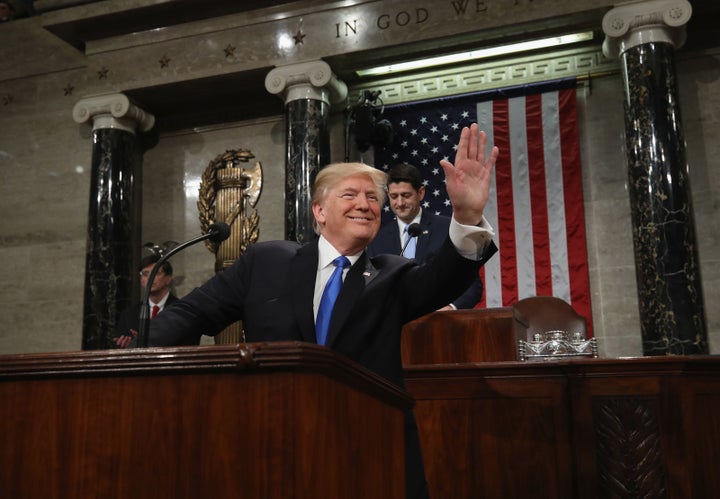
Here's The Full Text Of President Trump's First State Of The Union Address

Win Mcnamee / Getty Images

President Donald Trump is delivering his first State of the Union address to Congress. The White House released his remarks as prepared for delivery.

Mr. Speaker, Mr. Vice President, Members of Congress, the First Lady of the United States, and my fellow Americans:

Less than 1 year has passed since I first stood at this podium, in this majestic chamber, to speak on behalf of the American People -- and to address their concerns, their hopes, and their dreams. That night, our new Administration had already taken swift action. A new tide of optimism was already sweeping across our land.

Each day since, we have gone forward with a clear vision and a righteous mission -- to make America great again for all Americans.

Over the last year, we have made incredible progress and achieved extraordinary success. We have faced challenges we expected, and others we could never have imagined. We have shared in the heights of victory and the pains of hardship. We endured floods and fires and storms. But through it all, we have seen the beauty of America's soul, and the steel in America's spine.

Each test has forged new American heroes to remind us who we are, and show us what we can be.

We saw the volunteers of the "Cajun Navy," racing to the rescue with their fishing boats to save people in the aftermath of a devastating hurricane.

We saw strangers shielding strangers from a hail of gunfire on the Las Vegas strip.

We heard tales of Americans like Coast Guard Petty Officer Ashlee Leppert, who is here tonight in the gallery with Melania. Ashlee was aboard one of the first helicopters on the scene in Houston during Hurricane Harvey. Through 18 hours of wind and rain, Ashlee braved live power lines and deep water, to help save more than 40 lives. Thank you, Ashlee.

We heard about Americans like firefighter David Dahlberg. He is here with us too. David faced down walls of flame to rescue almost 60 children trapped at a California summer camp threatened by wildfires.

To everyone still recovering in Texas, Florida, Louisiana, Puerto Rico, the Virgin Islands, California, and everywhere else -- we are with you, we love you, and we will pull through together.

Some trials over the past year touched this chamber very personally. With us tonight is one of the toughest people ever to serve in this House -- a guy who took a bullet, almost died, and was back to work three and a half months later: the legend from Louisiana, Congressman Steve Scalise.

We are incredibly grateful for the heroic efforts of the Capitol Police Officers, the Alexandria Police, and the doctors, nurses, and paramedics who saved his life, and the lives of many others in this room.

In the aftermath of that terrible shooting, we came together, not as Republicans or Democrats, but as representatives of the people. But it is not enough to come together only in times of tragedy. Tonight, I call upon all of us to set aside our differences, to seek out common ground, and to summon the unity we need to deliver for the people we were elected to serve.

Over the last year, the world has seen what we always knew: that no people on Earth are so fearless, or daring, or determined as Americans. If there is a mountain, we climb it. If there is a frontier, we cross it. If there is a challenge, we tame it. If there is an opportunity, we seize it.

So let us begin tonight by recognizing that the state of our Union is strong because our people are strong.

And together, we are building a safe, strong, and proud America.

Since the election, we have created 2.4 million new jobs, including 200,000 new jobs in manufacturing alone. After years of wage stagnation, we are finally seeing rising wages.

Unemployment claims have hit a 45-year low. African-American unemployment stands at the lowest rate ever recorded, and Hispanic American unemployment has also reached the lowest levels in history.

Small business confidence is at an all-time high. The stock market has smashed one record after another, gaining $8 trillion in value. That is great news for Americans' 401k, retirement, pension, and college savings accounts.

And just as I promised the American people from this podium 11 months ago, we enacted the biggest tax cuts and reforms in American history.

Our massive tax cuts provide tremendous relief for the middle class and small businesses.

To lower tax rates for hardworking Americans, we nearly doubled the standard deduction for everyone. Now, the first $24,000 earned by a married couple is completely tax-free. We also doubled the child tax credit.

A typical family of four making $75,000 will see their tax bill reduced by $2,000 -- slashing their tax bill in half.

This April will be the last time you ever file under the old broken system -- and millions of Americans will have more take-home pay starting next month.

We eliminated an especially cruel tax that fell mostly on Americans making less than $50,000 a year -- forcing them to pay tremendous penalties simply because they could not afford government-ordered health plans. We repealed the core of disastrous Obamacare -- the individual mandate is now gone.

We slashed the business tax rate from 35 percent all the way down to 21 percent, so American companies can compete and win against anyone in the world. These changes alone are estimated to increase average family income by more than $4,000.

Small businesses have also received a massive tax cut, and can now deduct 20 percent of their business income.

Here tonight are Steve Staub and Sandy Keplinger of Staub Manufacturing -- a small business in Ohio. They have just finished the best year in their 20-year history. Because of tax reform, they are handing out raises, hiring an additional 14 people, and expanding into the building next door.

One of Staub's employees, Corey Adams, is also with us tonight. Corey is an all-American worker. He supported himself through high school, lost his job during the 2008 recession, and was later hired by Staub, where he trained to become a welder. Like many hardworking Americans, Corey plans to invest his tax‑cut raise into his new home and his two daughters' education. Please join me in congratulating Corey.

Since we passed tax cuts, roughly 3 million workers have already gotten tax cut bonuses -- many of them thousands of dollars per worker. Apple has just announced it plans to invest a total of $350 billion in America, and hire another 20,000 workers.

This is our new American moment. There has never been a better time to start living the American Dream.

So to every citizen watching at home tonight -- no matter where you have been, or where you come from, this is your time. If you work hard, if you believe in yourself, if you believe in America, then you can dream anything, you can be anything, and together, we can achieve anything.

Tonight, I want to talk about what kind of future we are going to have, and what kind of Nation we are going to be. All of us, together, as one team, one people, and one American family.

We all share the same home, the same heart, the same destiny, and the same great American flag.

Together, we are rediscovering the American way.

In America, we know that faith and family, not government and bureaucracy, are the center of the American life. Our motto is "in God we trust."

And we celebrate our police, our military, and our amazing veterans as heroes who deserve our total and unwavering support.

Here tonight is Preston Sharp, a 12-year-old boy from Redding, California, who noticed that veterans' graves were not marked with flags on Veterans Day. He decided to change that, and started a movement that has now placed 40,000 flags at the graves of our great heroes. Preston: a job well done.

Young patriots like Preston teach all of us about our civic duty as Americans. Preston's reverence for those who have served our Nation reminds us why we salute our flag, why we put our hands on our hearts for the pledge of allegiance, and why we proudly stand for the national anthem.

Americans love their country. And they deserve a Government that shows them the same love and loyalty in return.

For the last year we have sought to restore the bonds of trust between our citizens and their Government.

Working with the Senate, we are appointing judges who will interpret the Constitution as written, including a great new Supreme Court Justice, and more circuit court judges than any new administration in the history of our country.

We are defending our Second Amendment, and have taken historic actions to protect religious liberty.

And we are serving our brave veterans, including giving our veterans choice in their healthcare decisions. Last year, the Congress passed, and I signed, the landmark VA Accountability Act. Since its passage, my Administration has already removed more than 1,500 VA employees who failed to give our veterans the care they deserve -- and we are hiring talented people who love our vets as much as we do.

I will not stop until our veterans are properly taken care of, which has been my promise to them from the very beginning of this great journey.

All Americans deserve accountability and respect -- and that is what we are giving them. So tonight, I call on the Congress to empower every Cabinet Secretary with the authority to reward good workers -- and to remove Federal employees who undermine the public trust or fail the American people.

In our drive to make Washington accountable, we have eliminated more regulations in our first year than any administration in history.

We have ended the war on American Energy -- and we have ended the war on clean coal. We are now an exporter of energy to the world.

In Detroit, I halted Government mandates that crippled America's autoworkers -- so we can get the Motor City revving its engines once again.

Many car companies are now building and expanding plants in the United States -- something we have not seen for decades. Chrysler is moving a major plant from Mexico to Michigan; Toyota and Mazda are opening up a plant in Alabama. Soon, plants will be opening up all over the country. This is all news Americans are unaccustomed to hearing -- for many years, companies and jobs were only leaving us. But now they are coming back.

Exciting progress is happening every day.

To speed access to breakthrough cures and affordable generic drugs, last year the FDA approved more new and generic drugs and medical devices than ever before in our history.

We also believe that patients with terminal conditions should have access to experimental treatments that could potentially save their lives.

People who are terminally ill should not have to go from country to country to seek a cure -- I want to give them a chance right here at home. It is time for the Congress to give these wonderful Americans the "right to try."

One of my greatest priorities is to reduce the price of prescription drugs. In many other countries, these drugs cost far less than what we pay in the United States. That is why I have directed my Administration to make fixing the injustice of high drug prices one of our top priorities. Prices will come down.

America has also finally turned the page on decades of unfair trade deals that sacrificed our prosperity and shipped away our companies, our jobs, and our Nation's wealth.

The era of economic surrender is over.

From now on, we expect trading relationships to be fair and to be reciprocal.

We will work to fix bad trade deals and negotiate new ones.

And we will protect American workers and American intellectual property, through strong enforcement of our trade rules.

As we rebuild our industries, it is also time to rebuild our crumbling infrastructure.

America is a nation of builders. We built the Empire State Building in just 1 year -- is it not a disgrace that it can now take 10 years just to get a permit approved for a simple road?

I am asking both parties to come together to give us the safe, fast, reliable, and modern infrastructure our economy needs and our people deserve.

Tonight, I am calling on the Congress to produce a bill that generates at least $1.5 trillion for the new infrastructure investment we need.

Every Federal dollar should be leveraged by partnering with State and local governments and, where appropriate, tapping into private sector investment -- to permanently fix the infrastructure deficit.

Any bill must also streamline the permitting and approval process -- getting it down to no more than two years, and perhaps even one.

Together, we can reclaim our building heritage. We will build gleaming new roads, bridges, highways, railways, and waterways across our land. And we will do it with American heart, American hands, and American grit.

We want every American to know the dignity of a hard day's work. We want every child to be safe in their home at night. And we want every citizen to be proud of this land that we love.

We can lift our citizens from welfare to work, from dependence to independence, and from poverty to prosperity.

As tax cuts create new jobs, let us invest in workforce development and job training. Let us open great vocational schools so our future workers can learn a craft and realize their full potential. And let us support working families by supporting paid family leave.

As America regains its strength, this opportunity must be extended to all citizens. That is why this year we will embark on reforming our prisons to help former inmates who have served their time get a second chance.

Struggling communities, especially immigrant communities, will also be helped by immigration policies that focus on the best interests of American workers and American families.

For decades, open borders have allowed drugs and gangs to pour into our most vulnerable communities. They have allowed millions of low-wage workers to compete for jobs and wages against the poorest Americans. Most tragically, they have caused the loss of many innocent lives.

Here tonight are two fathers and two mothers: Evelyn Rodriguez, Freddy Cuevas, Elizabeth Alvarado, and Robert Mickens. Their two teenage daughters -- Kayla Cuevas and Nisa Mickens -- were close friends on Long Island. But in September 2016, on the eve of Nisa's 16th Birthday, neither of them came home. These two precious girls were brutally murdered while walking together in their hometown. Six members of the savage gang MS-13 have been charged with Kayla and Nisa's murders. Many of these gang members took advantage of glaring loopholes in our laws to enter the country as unaccompanied alien minors ‑- and wound up in Kayla and Nisa's high school.

Evelyn, Elizabeth, Freddy, and Robert: Tonight, everyone in this chamber is praying for you. Everyone in America is grieving for you. And 320 million hearts are breaking for you. We cannot imagine the depth of your sorrow, but we can make sure that other families never have to endure this pain.

Tonight, I am calling on the Congress to finally close the deadly loopholes that have allowed MS-13, and other criminals, to break into our country. We have proposed new legislation that will fix our immigration laws, and support our ICE and Border Patrol Agents, so that this cannot ever happen again.

The United States is a compassionate nation. We are proud that we do more than any other country to help the needy, the struggling, and the underprivileged all over the world. But as President of the United States, my highest loyalty, my greatest compassion, and my constant concern is for America's children, America's struggling workers, and America's forgotten communities. I want our youth to grow up to achieve great things. I want our poor to have their chance to rise.

So tonight, I am extending an open hand to work with members of both parties -- Democrats and Republicans -- to protect our citizens of every background, color, religion, and creed. My duty, and the sacred duty of every elected official in this chamber, is to defend Americans -- to protect their safety, their families, their communities, and their right to the American Dream. Because Americans are dreamers too.

Here tonight is one leader in the effort to defend our country: Homeland Security Investigations Special Agent Celestino Martinez -- he goes by CJ. CJ served 15 years in the Air Force before becoming an ICE agent and spending the last 15 years fighting gang violence and getting dangerous criminals off our streets. At one point, MS-13 leaders ordered CJ's murder. But he did not cave to threats or fear. Last May, he commanded an operation to track down gang members on Long Island. His team has arrested nearly 400, including more than 220 from MS-13.

CJ: Great work. Now let us get the Congress to send you some reinforcements.

Over the next few weeks, the House and Senate will be voting on an immigration reform package.

In recent months, my Administration has met extensively with both Democrats and Republicans to craft a bipartisan approach to immigration reform. Based on these discussions, we presented the Congress with a detailed proposal that should be supported by both parties as a fair compromise -- one where nobody gets everything they want, but where our country gets the critical reforms it needs.

Here are the four pillars of our plan:

The first pillar of our framework generously offers a path to citizenship for 1.8 million illegal immigrants who were brought here by their parents at a young age -- that covers almost three times more people than the previous administration. Under our plan, those who meet education and work requirements, and show good moral character, will be able to become full citizens of the United States.

The second pillar fully secures the border. That means building a wall on the Southern border, and it means hiring more heroes like CJ to keep our communities safe. Crucially, our plan closes the terrible loopholes exploited by criminals and terrorists to enter our country -- and it finally ends the dangerous practice of "catch and release."

The third pillar ends the visa lottery -- a program that randomly hands out green cards without any regard for skill, merit, or the safety of our people. It is time to begin moving towards a merit-based immigration system -- one that admits people who are skilled, who want to work, who will contribute to our society, and who will love and respect our country.

The fourth and final pillar protects the nuclear family by ending chain migration. Under the current broken system, a single immigrant can bring in virtually unlimited numbers of distant relatives. Under our plan, we focus on the immediate family by limiting sponsorships to spouses and minor children. This vital reform is necessary, not just for our economy, but for our security, and our future.

In recent weeks, two terrorist attacks in New York were made possible by the visa lottery and chain migration. In the age of terrorism, these programs present risks we can no longer afford.

It is time to reform these outdated immigration rules, and finally bring our immigration system into the 21st century.

These four pillars represent a down-the-middle compromise, and one that will create a safe, modern, and lawful immigration system.

For over 30 years, Washington has tried and failed to solve this problem. This Congress can be the one that finally makes it happen.

Most importantly, these four pillars will produce legislation that fulfills my ironclad pledge to only sign a bill that puts America first. So let us come together, set politics aside, and finally get the job done.

These reforms will also support our response to the terrible crisis of opioid and drug addiction.

In 2016, we lost 64,000 Americans to drug overdoses: 174 deaths per day. Seven per hour. We must get much tougher on drug dealers and pushers if we are going to succeed in stopping this scourge.

My Administration is committed to fighting the drug epidemic and helping get treatment for those in need. The struggle will be long and difficult -- but, as Americans always do, we will prevail.

As we have seen tonight, the most difficult challenges bring out the best in America.

We see a vivid expression of this truth in the story of the Holets family of New Mexico. Ryan Holets is 27 years old, and an officer with the Albuquerque Police Department. He is here tonight with his wife Rebecca. Last year, Ryan was on duty when he saw a pregnant, homeless woman preparing to inject heroin. When Ryan told her she was going to harm her unborn child, she began to weep. She told him she did not know where to turn, but badly wanted a safe home for her baby.

In that moment, Ryan said he felt God speak to him: "You will do it -- because you can." He took out a picture of his wife and their four kids. Then, he went home to tell his wife Rebecca. In an instant, she agreed to adopt. The Holets named their new daughter Hope.

Ryan and Rebecca: You embody the goodness of our Nation. Thank you, and congratulations.

As we rebuild America's strength and confidence at home, we are also restoring our strength and standing abroad.

Around the world, we face rogue regimes, terrorist groups, and rivals like China and Russia that challenge our interests, our economy, and our values. In confronting these dangers, we know that weakness is the surest path to conflict, and unmatched power is the surest means of our defense.

For this reason, I am asking the Congress to end the dangerous defense sequester and fully fund our great military.

As part of our defense, we must modernize and rebuild our nuclear arsenal, hopefully never having to use it, but making it so strong and powerful that it will deter any acts of aggression. Perhaps someday in the future there will be a magical moment when the countries of the world will get together to eliminate their nuclear weapons. Unfortunately, we are not there yet.

Last year, I also pledged that we would work with our allies to extinguish ISIS from the face of the Earth. One year later, I am proud to report that the coalition to defeat ISIS has liberated almost 100 percent of the territory once held by these killers in Iraq and Syria. But there is much more work to be done. We will continue our fight until ISIS is defeated.

Army Staff Sergeant Justin Peck is here tonight. Near Raqqa last November, Justin and his comrade, Chief Petty Officer Kenton Stacy, were on a mission to clear buildings that ISIS had rigged with explosives so that civilians could return to the city.

Clearing the second floor of a vital hospital, Kenton Stacy was severely wounded by an explosion. Immediately, Justin bounded into the booby-trapped building and found Kenton in bad shape. He applied pressure to the wound and inserted a tube to reopen an airway. He then performed CPR for 20 straight minutes during the ground transport and maintained artificial respiration through 2 hours of emergency surgery.

Kenton Stacy would have died if not for Justin's selfless love for a fellow warrior. Tonight, Kenton is recovering in Texas. Raqqa is liberated. And Justin is wearing his new Bronze Star, with a "V" for "Valor." Staff Sergeant Peck: All of America salutes you.

Terrorists who do things like place bombs in civilian hospitals are evil. When possible, we annihilate them. When necessary, we must be able to detain and question them. But we must be clear: Terrorists are not merely criminals. They are unlawful enemy combatants. And when captured overseas, they should be treated like the terrorists they are.

In the past, we have foolishly released hundreds of dangerous terrorists, only to meet them again on the battlefield -- including the ISIS leader, al-Baghdadi.

So today, I am keeping another promise. I just signed an order directing Secretary Mattis to reexamine our military detention policy and to keep open the detention facilities at Guantánamo Bay.

I am also asking the Congress to ensure that, in the fight against ISIS and al-Qa'ida, we continue to have all necessary power to detain terrorists -- wherever we chase them down.

Our warriors in Afghanistan also have new rules of engagement. Along with their heroic Afghan partners, our military is no longer undermined by artificial timelines, and we no longer tell our enemies our plans.

Last month, I also took an action endorsed unanimously by the Senate just months before: I recognized Jerusalem as the capital of Israel.

Shortly afterwards, dozens of countries voted in the United Nations General Assembly against America's sovereign right to make this recognition. American taxpayers generously send those same countries billions of dollars in aid every year.

That is why, tonight, I am asking the Congress to pass legislation to help ensure American foreign-assistance dollars always serve American interests, and only go to America's friends.

As we strengthen friendships around the world, we are also restoring clarity about our adversaries.

When the people of Iran rose up against the crimes of their corrupt dictatorship, I did not stay silent. America stands with the people of Iran in their courageous struggle for freedom.

I am asking the Congress to address the fundamental flaws in the terrible Iran nuclear deal.

My Administration has also imposed tough sanctions on the communist and socialist dictatorships in Cuba and Venezuela.

But no regime has oppressed its own citizens more totally or brutally than the cruel dictatorship in North Korea.

North Korea's reckless pursuit of nuclear missiles could very soon threaten our homeland.

We are waging a campaign of maximum pressure to prevent that from happening.

Past experience has taught us that complacency and concessions only invite aggression and provocation. I will not repeat the mistakes of past administrations that got us into this dangerous position.

We need only look at the depraved character of the North Korean regime to understand the nature of the nuclear threat it could pose to America and our allies.

Otto Warmbier was a hardworking student at the University of Virginia. On his way to study abroad in Asia, Otto joined a tour to North Korea. At its conclusion, this wonderful young man was arrested and charged with crimes against the state. After a shameful trial, the dictatorship sentenced Otto to 15 years of hard labor, before returning him to America last June -- horribly injured and on the verge of death. He passed away just days after his return.

Otto's Parents, Fred and Cindy Warmbier, are with us tonight -- along with Otto's brother and sister, Austin and Greta. You are powerful witnesses to a menace that threatens our world, and your strength inspires us all. Tonight, we pledge to honor Otto's memory with American resolve.

Finally, we are joined by one more witness to the ominous nature of this regime. His name is Mr. Ji Seong-ho.

In 1996, Seong-ho was a starving boy in North Korea. One day, he tried to steal coal from a railroad car to barter for a few scraps of food. In the process, he passed out on the train tracks, exhausted from hunger. He woke up as a train ran over his limbs. He then endured multiple amputations without anything to dull the pain. His brother and sister gave what little food they had to help him recover and ate dirt themselves -- permanently stunting their own growth. Later, he was tortured by North Korean authorities after returning from a brief visit to China. His tormentors wanted to know if he had met any Christians. He had -- and he resolved to be free.

Seong-ho traveled thousands of miles on crutches across China and Southeast Asia to freedom. Most of his family followed. His father was caught trying to escape, and was tortured to death.

Today he lives in Seoul, where he rescues other defectors, and broadcasts into North Korea what the regime fears the most ‑- the truth.

Today he has a new leg, but Seong-ho, I understand you still keep those crutches as a reminder of how far you have come. Your great sacrifice is an inspiration to us all.

Seong-ho's story is a testament to the yearning of every human soul to live in freedom.

It was that same yearning for freedom that nearly 250 years ago gave birth to a special place called America. It was a small cluster of colonies caught between a great ocean and a vast wilderness. But it was home to an incredible people with a revolutionary idea: that they could rule themselves. That they could chart their own destiny. And that, together, they could light up the world.

That is what our country has always been about. That is what Americans have always stood for, always strived for, and always done.

Atop the dome of this Capitol stands the Statue of Freedom. She stands tall and dignified among the monuments to our ancestors who fought and lived and died to protect her.

Monuments to Washington and Jefferson -- to Lincoln and King.

Memorials to the heroes of Yorktown and Saratoga -- to young Americans who shed their blood on the shores of Normandy, and the fields beyond. And others, who went down in the waters of the Pacific and the skies over Asia.

And freedom stands tall over one more monument: this one. This Capitol. This living monument to the American people.

A people whose heroes live not only in the past, but all around us -- defending hope, pride, and the American way.

They work in every trade. They sacrifice to raise a family. They care for our children at home. They defend our flag abroad. They are strong moms and brave kids. They are firefighters, police officers, border agents, medics, and Marines.

But above all else, they are Americans. And this Capitol, this city, and this Nation, belong to them.

Our task is to respect them, to listen to them, to serve them, to protect them, and to always be worthy of them.

Americans fill the world with art and music. They push the bounds of science and discovery. And they forever remind us of what we should never forget: The people dreamed this country. The people built this country. And it is the people who are making America great again.

As long as we are proud of who we are, and what we are fighting for, there is nothing we cannot achieve.

As long as we have confidence in our values, faith in our citizens, and trust in our God, we will not fail.

Our families will thrive.

Our people will prosper.

And our Nation will forever be safe and strong and proud and mighty and free.

Thank you, and God bless America.


Source BuzzFeed - Politics http://ift.tt/2npw2rC

Monday, January 29, 2018

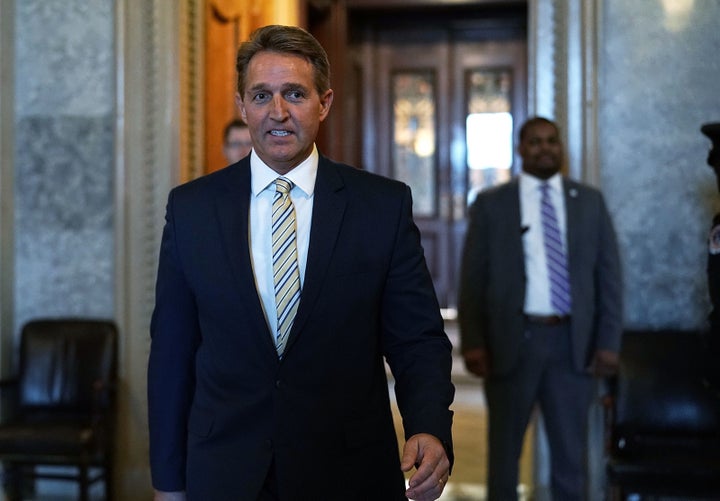
Jeff Flake Is The Latest Republican To Give Up A Steve Wynn Donation

Sen. Jeff Flake of Arizona.

Alex Wong / Getty Images

Arizona Sen. Jeff Flake has joined a growing list of Republicans disavowing donations from Steve Wynn, the casino magnate who resigned as the Republican National Committee's chief fundraiser amid accusations of sexual misconduct.

Flake's campaign will make a $2,700 contribution — the same amount it collected from Wynn last year — to a yet-to-be-determined charity, Flake spokesperson Jason Samuels told BuzzFeed News in a Monday afternoon email.

Wynn had given the maximum $5,400 to Flake in 2017: $2,700 each for the primary and general election. But the senator, who was facing a tough primary challenger from the right wing of the GOP, returned the general election donation after announcing in October that he would not seek reelection, Samuels said.

Other Republicans have said they plan to purge their campaign funds of Wynn's money. They include, according to the Associated Press and the Wall Street Journal, which broke the Wynn story, House Speaker Paul Ryan of Wisconsin; Sen. Dean Heller of Nevada; Sen. Ron Johnson of Wisconsin; Sen. Rob Portman of Ohio; Rep. Greg Gianforte of Montana, and Rep. Karen Handel of Georgia.

The RNC confirmed Wynn's resignation as finance chair Saturday, following a call between Chairwoman Ronna Romney McDaniel and President Trump. But officials with the RNC have yet to say what it plans to do with Wynn's contributions directly to the party — a total of about $69,000 last year. McDaniel had been among those pushing for Democrats to return contributions from Hollywood mogul Harvey Weinstein after sexual misconduct accusations surfaced against him last fall.

During a Monday appearance on MSNBC, former White House press secretary and RNC communications director Sean Spicer said the RNC should return "any money that happened this cycle, absolutely."

Spicer added that "the right thing to do for the Republican Party is to have the higher moral ground and say, ‘We’re going to return the money.’”


Source BuzzFeed - Politics http://ift.tt/2nkZ6AD

A global heatmap from GPS-tracking company Strava that tracks people's exercise habits could pose security risks for military forces around the world.


Source CNN.com - RSS Channel - App Tech Section http://ift.tt/2BztbAW

The Past Year And The Breakdown Of Institutional Power

Carlos Barria / Reuters

Donald Trump has an unusual kind of power: He reveals weakness.

This quality he extends to all things — people, traditions, movements — and while you know all this by now, the way he traffics in lingering doubts (e.g., Lyin’ Ted) and the malleable dignity of those around him, in all the small compromises people make with themselves toward an end, what all these individual shortfalls do in the aggregate is to expose the fragility of our modern, national institutions.

What exactly, for instance, is supposed to happen if the president wonders why we accept immigrants from “shithole” countries? Or says a group of white supremacists included “very fine” people? Backhandedly calls the North Korean dictator short and fat?

Nothing, of course. There’s no institution to guard against any of that. And since there’s no way to quantify the harm in any of it, either, (no laws broken, no physical destruction) all these things that President Trump says just land in a weird, rhetorical DMZ, where there is no recourse. That unease defined the last year. And it’s this kind of phantom feeling that something should’ve happened, but didn’t or won’t, that flows through each of the central stories of the moment: Trump’s presidency, the nightmare revelations of sexual abuse, and the accumulating problems of Facebook, Twitter, and YouTube. What brings all these things together is the assault, from the White House and from journalists, for worse and for better, on core institutions.

With Trump, it’s like constantly watching a flyball fall between a shortstop and a left fielder — that kind of suspended anxiety freefall, where nobody REALLY knows what to do, because there’s nothing to do. Morning in America is disorientingly open with possibility, because who knows where Trump will take things next?

“It’s oddly riveting,” George Saunders wrote during the campaign, nearly two years ago, “watching someone take such pleasure in going so much farther out on thin ice than anyone else as famous would dare to go.” Nobody ever decided whether that dynamic drove or hindered Trump’s success, but what it definitely did was expose the extent to which the American political system was relying on shame to keep it in check.

Trump constantly subverted the expectation of what a normal candidate would do (e.g., apologize for accusing Judge Curiel of bias based on his Mexican-American heritage) by never conceding any mistake. The idea generally is that campaigns, like corporations, are basically built to apologize, walk back, and/or preemptively manage expectations so that the minimal number of voters take offense at any given thing. Trump rejected that framework entirely, but stretched the understanding of what was normal so far that there was a sense (a flame that apparently burns eternal) that some objective, imagined hand of authority — the Republican Party or the RNC or the delegates at the convention — would step in. No one did, because the uneasy reality is that candidates and their own campaigns alone govern the candidate and campaign’s conduct. If you’re unafraid of the public’s distaste, there are a lot of places you can run with that. Basically: If a candidate says, well, listen, I’m doing this and you can’t stop me — maybe you actually can’t. Trump, then, is like some classically Greek, Shakespearean character sent to reveal that weakness in the system.

That has produced some nostalgia from all different sides for back before, when a political party might change the rules on a candidate, or the media could more tightly control what viewers saw and heard. But these are also the same kind of institutional controls that made all Harvey Weinstein’s accusers go away for so long, and that realization — the way institutions made bad things go away — links the a lot of these kinds of stories.

Smash the exterior of an institution and you may reveal catacombs of cruelty, shame, sickness, all the terrible things people with power can do those without it in the corridor of a hotel suite, inside an office, inside a home, in small places you feel as though you are not meant to be. This past year dropped floodlights into the Biblical depths of human behavior — the way an obsession with control or some sadness within a person can curdle and warp in the dark of a professional, civilized society. And for all the righteous strength witnessed in and derived from the crack-up of an open secret, each begins with long-suppressed anguish. “That’s the most horrible part of it,” Lucia Evans told the New Yorker of Harvey Weinstein. “People give up, and then they feel like it’s their fault.”

If you read all these stories and start writing down (or calculating out) the ages of the people in them, the interns and assistants and desk assistants and students, especially the women (and men) whose names you’ve never heard before, a pattern emerges. “We were so young at the time,” Karen Katz, who’d worked at Weinstein’s Miramax, told the Times. “We did not understand how wrong it was or how [she] should deal with it.” Many of these stories concern people too inexperienced to know who to tell, or how or when. “I still on some level thought I had been a tiny adult,” one man explained of how he did not appreciate, until he was an adult, the way he says Kevin Spacey abused him when he was 14. “I assumed I was the problem for thinking badly of you,” Aly Raisman said of Larry Nassar, the Olympic doctor who is accused of abusing more than a hundred girls. “I wouldn’t allow myself to believe that the problem was you.”

A robust institution can be isolating in that way. You can’t identify patterns like those alone. You can suffer alone, questioning even your own story. You can also be the cool cynic wise to the harsh ways of the world (“I felt a weird sense of pride about being able to ‘handle’ the environment,” wrote a colleague) only to realize, in retrospect, years later, you were in over your head. “I was, like, ‘Look, man, I am no fucking fool,’”Asia Argento said of Weinstein. “But, looking back, I am a fucking fool. And I am still trying to come to grips with what happened.”

The wild and unsettling thing about the last six months is both the pervasiveness of abuse and harassment, and how what’s at the heart of an open secret often turns out to be much worse; there is sudden realization that maybe something terrible has been lurking beside you all along. Because it's apparently at the ballet, on the manufacturing floor, inside the massage parlor, in jail, at the Olympics, on the morning show, at the theater, on the radio, on the court, on Capitol Hill. This is where you can end up wondering what the point of a “civic institution” even is. And on the most basic level — in the most amateur hour intro philosophy seminar way — isn’t the idea that any one of these institutions (the church, the military, the government, the media, any of them) is meant to give people place and purpose, and to judiciously amplify some virtue in men (strength or kindness or charity), or to bend our collective power toward some common benefit (safety or prosperity), and above all, isn’t the idea to blunt wickedness? But here you have the agents that kept taking women to Weinstein, the studios that didn’t look at his finances, parts of the tabloid machine under his control, the way everyone seemed to know, and it’s like a blood disease — everything an institution is supposed to do, but corroded, and turned in on itself.

And then there’s all of us, consuming this weird year through our phones, living inside new institutions that are mind-blowing in scale and horribly ill-equipped for the task of handling us. Whatever it was that happened — the election? — something has shifted in the way the media, lawmakers, and even some people on them view the platforms.

“Facebook has grown so big, and become so totalizing, that we can’t really grasp it all at once,” Max Read wrote last year, listing off a dozen different comparisons the platform has elicited, from the Catholic church to a railroad company. “Like a four-dimensional object, we catch slices of it when it passes through the three-dimensional world we recognize.” Twitter (in 34 languages and producing inconceivable amounts of words every second) and YouTube (in 88 countries with people watching one billion hours each day) operate in similar dimensions.

Nobody can monitor that kind of volume — but algorithms can’t quite either, and so all kinds of bad behavior can only belatedly be contained, if at all.

YouTube will soon employ more than 10,000 people to screen videos (and train algorithms) to detect child exploitation (e.g., kids “restrained with ropes or tape”) and extremism (e.g., jihadi videos); that news preceded the 48 hours a (now former) YouTuber’s video lived online featuring a dead man’s body inside Japan’s suicide forest. Twitter still, still struggles with harassment, especially in places like India, where women are on the receiving end of harassment in six different local languages. In realms where political news gets delivered and consumed, the platform can feel constantly combative, meta, and wearing — kind of like a game of Hungry Hungry Hippos where the hippos are outfitted with razors. Facebook has found itself the host body for live shootings, dystopian authoritarian propaganda, and a philosophical debate about the meaning of news and truth, in which a small move could result in shifting reality for someone. Kevin Roose compared an admission from Facebook leadership that they did not realize ad targeting would be used to reach anti-Semites to Victor Frankenstein’s lament: “I lived in daily fear lest the monster whom I had created should perpetrate some new wickedness.”

Basically, the platforms are dealing with a. the loftiest, most existential of questions about information and speech, and b. every kind of domestic dispute in every small town across dozens of countries every hour of every day.

And every response to these super old problems — rumors, lies, abuse — tends to be thin and unsatisfying, almost alien, from the endless vow to improved transparency to Facebook’s intention to have two billion people decide the trustworthiness of news outlets. These are the products of a culture that sometimes “views nearly all content as agnostic, and everything else as a math problem.” The underlying principle to these platforms isn’t some huge mystery: Everything is keyed toward cascading reactions, an endless series of provocations, both good and bad. “I wish I could guarantee that the positives are destined to outweigh the negatives,” wrote Facebook’s Samidh Chakrabarti last week, “but I can’t.”

There’s been a lot of talk, over this first year of Trump, about an abstract sense that things are falling apart, or that it’s not the same country is used to be, or that this feels like the end to an era, even if what that era was cannot be so easily defined. This is, I think, partly a function of the way our phones intensify everything intellectually, in both good and bad ways, so that you can feel, within the space of minutes, a directionless jolt of anxiety at every Trump tweet about North Korea and the immersive warmth of texting with exactly you hope most to hear from. It is disorienting to know so much and feel so much all the time. It is also a function of the reality where we get hit again, and again, and again, with reminders that fundamental assumptions about the society we live in (that you can’t say that, that you can’t do that, that you couldn’t have hid something like that) aren’t really true. It’s too difficult to keep a secret in 2018, especially about the bad things people can do to each other.

So maybe it’s political insecurity that’s causing that static in the signal, or maybe it’s disillusionment with these old, sick systems that kept sending people to Harvey Weinstein and Larry Nassar, or maybe it’s the sense that the platforms are like big boxes that we’ve thrown the full crush of humanity into. Whatever it is, now we are free to tear apart every last institution until every last vestige of that kind of pain is gone, hurtling toward some new future where you can only hope the kindness in our hearts wins out. ●


Source BuzzFeed - Politics http://ift.tt/2DTUmLO

Sunday, January 28, 2018

Hillary Clinton Let Him Stay. Women Say His Harassment Continued.

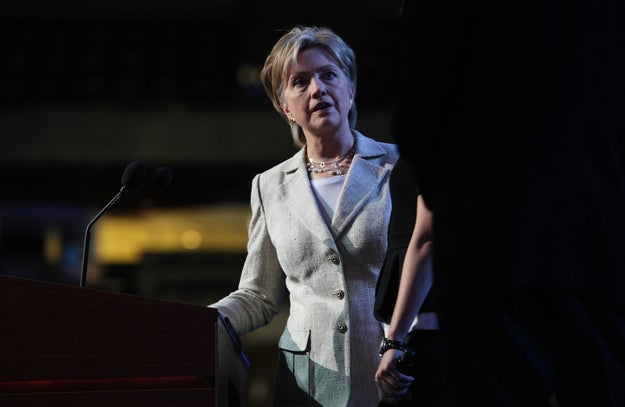
Hillary Clinton at the 2008 Democratic National Convention.

Justin Sullivan / Getty Images

In 2007, while working for the candidate who hoped to be the first female president, a young woman filed a complaint against her boss — the campaign’s faith adviser. She described “five kisses on the head” and “excessive tracking” of her whereabouts, among other complaints of harassment, according to campaign documents from the time.

Senior aides on the campaign wanted to fire him, according to three officials with knowledge of the process, but Hillary Clinton decided against doing so.

Not only was the adviser, Burns Strider, not pushed out — he thrived after her campaign, landing a senior role at a super PAC preparing for her next presidential bid. In that job, he exhibited the same kinds of inappropriate behavior toward women who worked there, particularly two young female subordinates.

In at least three separate instances between 2007 and 2015, women who worked for the Clinton campaign or the pro-Clinton PAC said that Strider, 52, harassed them at work.

All along, even after his departure from that super PAC, he was described in the press as a close friend and confidant to Clinton, someone with access to one of the most important people in the country. In meetings, he would refer to the “boss lady” and what she wanted done — a sign to people in the extended Clinton orbit that he wielded influence, especially in the eye of the young staffers who hoped to work for the first woman president.

This story is based on documents obtained from the 2008 campaign, months of emails and text messages, and more than two dozen interviews over the course of the last month, including with six people who worked for Strider at Correct the Record.

Burns Strider in 2016.

Rogelio V. Solis / AP

The two periods, one on a high-stakes presidential campaign and the other at a newly set-up super PAC, reflect a culture in politics where harassment can easily go unreported or unaddressed — and even a campaign seeking to shatter glass ceilings can play host to old-fashioned harassment. On campaigns, if complaints arise, they do so in an environment where the candidate’s public perception is an inherent priority. At super PACs, the offices are small and fast-paced, often formed without robust human resource departments and staffed by young, aspiring operatives. And in the tiny world of Washington, personal relationships influence hiring — and young staffers come to fear that any perceived wrong move could damage relationships or end careers.

On Saturday, Strider did not deny that his behavior had been inappropriate.

Speaking by phone in a 45-minute call, he addressed claims laid out for him in a 16-point email, sent by BuzzFeed News. He acknowledged many of the incidents as true. Others, he said, he did not recall in the same way as the women interviewed for this report. He dismissed some of his actions as simply friendly, or characteristic of what he described as his Southern background. At the same time, he apologized broadly for his behavior, and noted that he has struggled with depression and is in therapy. In the case of his conduct toward the woman who worked for him on the Clinton campaign in 2007, Strider said, “I didn't consider it excessive, but that doesn't mean it wasn't to her.”

The New York Times first reported on allegations against Strider, and Clinton’s decision to not fire him.

On Friday evening, Clinton tweeted that she had called the woman who made the 2007 complaint to tell her “how proud I am of her and to make sure she knows what all women should: we deserve to be heard.” Of the 2007 events, Clinton wrote that she was “dismayed when it occurred, but was heartened the young woman came forward, was heard, and had her concerns taken seriously and addressed.”

Clinton, who has not been especially vocal about the #MeToo wave of sexual misconduct allegations, has a complicated public relationship with the changing expectations for how claims of sexual harassment and abuse are handled. During her 2016 campaign, she tweeted that every victim of sexual assault had “the right to be believed,” which became a point of criticism, particularly on the right. After a woman in New Hampshire asked Clinton in 2015 whether the women who had accused President Bill Clinton of sexual harassment and assault should be believed, Clinton responded, “Well, I would say that everybody should be believed at first until they are disbelieved based on evidence.”

Before she launched her first presidential campaign, Clinton hired Strider in 2006 to oversee faith outreach. Strider had worked his way up from the office of a Mississippi congressman to the Democratic Congressional Campaign Committee, to the office of Minority Leader Nancy Pelosi. He helped launch the Faith Working Group, a congressional initiative meant to combat the perception that Democrats are anti-religion. "For a long time,” he said in 2007, “Democrats forfeited part of the electorate by choosing not to have a conversation about faith." Strider, a Southern Baptist from Mississippi, positioned himself as the Democratic Party's “faith guru,” connecting candidates with religious leaders.

"God's not a mascot we're going to run out when we want to feel good," the American-Statesman quoted him telling reporters in the fall of 2007, during his time on the Clinton campaign. "You've got to be real in this faith and politics business or it's not going to work."

In November 2007, a direct subordinate filed a complaint about Strider within the Clinton campaign, according to documents obtained by BuzzFeed News. The woman in the complaint, whom BuzzFeed News is not naming, did not respond to emails this week.

The complaint was filed to Jessica O’Connell, the national director of operations, and quickly rose to the attention of the campaign manager, Patti Solis Doyle, and eventually, to Clinton herself, according to documents and accounts from three former campaign officials.

On Nov. 15, 2007, the young woman sat for an interview with a top campaign official. Notes about that meeting describe her account of Strider’s behavior as follows:

  • gets “angry when she does not share or reveal personal information”

  • is “touchy,” including “5 kisses on the head (on one occasion closing the door to do so, one occasion in the elevator)”

  • “wants her to leave all events with him”

  • “makes a point of always leaving with her (she varies her times to try to avoid him, but he asks her to wait so they can commute together)”

  • engages in “excessive tracking of whereabouts”

  • “said he loved her as a friend”

  • “told her he wants to get her drunk”

  • “told her he buys porn while on the road for travel”

The complaint documents also include emails that Strider sent to the woman on successive nights. The first, sent on Nov. 13, 2007, at 11:35 p.m., opens and closes with comments about what seems to be a work-related project for the campaign’s faith outreach. In between, however, Strider wrote, “Again… Very very sorry for the drunk comment… You know how I think you’re a radiant daybreak BUT that comment was really out of line… So sorry…”

The next night, at 10:44 p.m., according to the complaint, Strider sent the following email, subject lined, “Hey…”

There’s no need to react to this email… Don’t want you jumping at me :) I’m thinking about you… Mercy I hope you’re having a good evening… I haven’t met anyone as amazing as you are in a very long time… And its [sic] ALL of you that’s amazing… The whole package [name redacted]. You have an internal and external poise and beauty that is so compelling. People are better off for knowing you. I count myself at the top of that list. You bring so much more into a relationship than I ever could… Look, I can’t type as much as I’d like on this bb. And you don’t want to hear it all… And you likely don’t benefit that much from what I have to say… I just want you to understand how valuable you are in the lives of people who encounter you and that its [sic] all of you that makes you that way… I hope you understand what I’m saying… You’re filling my mind tonight so I needed to share.

Hope, Joy, Celebration

Burns

The campaign’s top officials discussed how to handle the matter, and at some point in the days following the Nov. 15 interview, Hillary Clinton was briefed about the complaint. At that time, Solis Doyle, the campaign manager, advised that Strider should be fired, according to the three former officials. O’Connell, the national director of operations, had also recommended that Strider should be fired.

In the end, the former officials said, Clinton decided to keep Strider in his role.

Solis Doyle declined to comment. O’Connell, now the chief executive officer of the Democratic National Committee, declined to comment.

A spokesman for Clinton, Nick Merrill, also declined to comment. He provided a statement from the law firm that represented the campaign in 2008, Utrecht, Kleinfeld, Fiori, Partners: “To ensure a safe working environment, the campaign had a process to address complaints of misconduct or harassment. When matters arose, they were reviewed in accordance with these policies, and appropriate action was taken. This complaint was no exception.”

On the morning of Nov. 20, five days after the woman filed her complaint, an attorney for the Clinton campaign emailed senior campaign officials with recommendations for an alternative course of action: Strider would be punished, but remained at the helm of faith outreach. The woman was removed from her role to a different department.

Addressed to Strider, the language stipulated that, effective Nov. 16, he would be docked in title and pay. “You will be demoted and your title and future compensation will be commensurate with a one step demotion,” the email reads. The recommendations also required Strider to complete counseling, and his campaign email would also be set up with controls preventing him from contacting the woman who lodged the complaint.

“If there is even a hint of another issue in this regard,” the language in the email reads, “the [campaign] will terminate you.”

On Saturday, Strider said he sought out his own therapist after the incident. He said the campaign followed up with him about counseling, and that he provided officials with the name of his therapist.

Addressing each component in the 2007 complaint, Strider denied only one — the comment about buying porn, which he attributed to a third person present during the apparent exchange. He said he frequently kissed people on the head, dating back to his days on Capitol Hill, describing the act of touching or kissing someone on the head as part of cheering staffers on and doing devotional blessings. “I quit doing that after ’08, and I picked it up again at Correct the Record,” he said, “because all my young researchers seemed to like it.”

He said he did not mean the kisses in a sexual manner. He also said that he has since stopped doing this.

Strider continued to serve in a senior role and travel with the campaign after the incident. In the spring of 2008, the New York Times published a short profile of his faith outreach efforts, detailing a campaign stop in North Carolina with Bill Clinton.

Strider said Saturday that he has never discussed the 2007 complaint with Hillary Clinton.

After Clinton lost, he launched a new political group, the American Values Network, a 501c4 organization billed as a self-described as a “progressive faith group.” When the group launched, a "Guide to Scripture and Policy" appeared on its website. "In the frantic pace of campaigns,” the introduction read, “this guide is intended to act as a quick reference on Biblical principles.”

Strider never left Clinton’s orbit. He appears in Clinton emails released by the State Department during her tenure as secretary, including devotionals he sent her during the time period. In 2016, Strider told a reporter he still sent Clinton daily devotional emails. “There’s many days where I don’t hear from her. Then on a Sunday night, I may get two or three responses.”

In November 2013, months after Clinton left the State Department, American Bridge — the Washington-based Democratic super PAC headed by longtime Clinton ally David Brock — announced that Strider would lead a new offshoot project called Correct the Record. Strider, presented to reporters at the time as a veteran campaign operative with close ties to Bill and Hillary Clinton, was also named vice president at American Bridge.

In his 18 months at the Correct the Record — a small shop of communications and research officials tasked with defending Clinton ahead of an all but certain presidential bid — Strider exhibited similar behavior toward the women in the office, particularly two young direct subordinates, according to six former employees.

The two women detailed their interactions with Strider in interviews this week.

The first woman, who asked not to be named to protect her privacy, described a boss who repeatedly commented on her looks, who engaged in "constant" touching, and who sought to closely monitor and control her activity inside and outside the office.

The woman arrived at Correct the Record at the same time as her boss. Quickly, she said, he started remarking on her looks, with comments like, "You look sexy.” The former subordinate also described "constant touching." Strider would rub her back and shoulders and approach her from behind to grab her waist, she said. She and three other former employees said Strider would offer unsolicited back rubs to female staffers while they sat at their work station, a long line of tables set up in Correct the Record's own corner of the American Bridge offices on Massachusetts Avenue in Washington.

In months’ worth of text messages and emails between Strider and the direct subordinate, provided by the woman this week, Strider repeatedly expressed his affection for her. In one text message, sent around 10 p.m. on Nov. 22, 2015, after the subordinate told Strider she was on her way home, he replied, "Your love for me is so palpable. Poor thing. Hang in there." In another text message, sent just after 10:30 p.m. on Feb. 18, 2014, he told her, "Fun tonight. You're funny. Make me smile."

The dozens of messages provided by the woman reflect many of the same complaints made against Strider in 2007.

The woman said he often became controlling, sending late-night texts and accessing her work calendar to monitor her whereabouts. If she had nothing scheduled at night, he would ask her to get drinks or join him at work events, she said. "We need some time to spend and talk," he told her in a December 2013 email about one such event. "Is an evening with me that terrible for you???" (At one point, the woman said, she began adding fake events to her calendar in an effort to avoid him.)

This was the woman's first job in national politics. At the time, she said, she told herself that Strider's behavior was simply part of the high-stakes, chaotic world of big-time campaigns and super PACs. She said Strider reinforced this view, telling her that she needed to be tougher if she hoped to work at the highest levels of Washington — while reminding her and other employees of his relationships in Clinton's orbit. In meetings, he referred to Clinton as "boss lady," the six former staffers said. When the subordinate once told him that she didn't want to be called "honey" and "baby," he told her he spoke that way to all his female friends, she said, including top Clinton ally Minyon Moore.

"I just felt like if you want to work in politics, you have to be tough enough to endure this,” the woman said. “I felt embarrassed quitting.”

In February 2014, Strider and the subordinate attended a work event in Mississippi. The woman's mother attended as a guest, and saw Strider rub her daughter's back while the two of them worked the event, the former subordinate said. The following week, she decided to quit, leaving Correct the Record that same day.

By then, she recalled, she had developed a bleak picture of life as a young political operative. "I just felt like if you want to work in politics, you have to be tough enough to endure this,” the woman said. “I felt embarrassed quitting.”

Strider did not dispute the authenticity of the emails and text messages outlined in this article, or dispute the inappropriate language attributed to him. “I've come to realize that those terms in the workplace are not preferred, by and large,” Strider said. “At the time, there were certainly terms I [used]. It's just something I have to broadly apologize for.”

He said that if he had access to anyone’s calendar, he did not know how to use it.

The second former direct subordinate joined Correct the Record in the spring of 2014, excited to work for a PAC laying the groundwork for a historic presidential campaign. She served under Strider for more than a year. Over that time, she said, he often made comments about her outfits and her body. She also described a manager who was controlling and could become explosively angry at the slightest provocation.

On one evening in early 2015, Strider and the employee shared an Uber home after a networking dinner in Washington, asking the driver to make two stops, dropping the woman off first. When the Uber pulled up outside her apartment, Strider got out of the car and kissed her on the tip of her nose, she said.

The next morning, rattled and upset, she walked into Strider’s office to confront him about the interaction, telling him that the kiss was inappropriate and could never happen again, she recalled. Strider, the woman said, apologized and told her that he adored her and thought of her as a little sister.

On Saturday, Strider said he did not remember the moment outside the Uber, but said that if it happened, he would have kissed the woman on the head, rather than the nose.

After the incident, the woman began looking for another job, she said, nervous to apply for openings at organizations where word might get back to Strider. The former staffer recalled feeling that Strider, a well-connected Washington operative and a link to the world around Hillary Clinton, could hinder her political career if he wanted to do so.

In May 2015, she found another job, accepted on the spot, and gave her notice, she said.

On Saturday, the woman’s lawyer, Ari Wilkenfeld, provided a statement on behalf of his client, speaking out in support of “an important movement like #MeToo” and the women who have come forward across a vast array of industries. “It’s very intimidating to open yourself up to such scrutiny like this, but it is essential,” Wilkenfeld said.

At Correct the Record, former employees said, women faced hurdles that seem uniquely tied to a culture of campaigns and super PACs. Both direct subordinates described feeling as if they had no way to take action inside a small political shop like Correct the Record. Although the project was housed at American Bridge, a large research and communications firm, six former staffers said they felt like Correct the Record offered no clear human resources department or reporting structure through which one might file a complaint. A senior official at American Bridge said Saturday that Correct the Record employees did have access to the resources at American Bridge, but that the reporting structure could have been clearer and more streamlined.

The group declined to comment on Strider.

In 2014, after the first direct subordinate had already departed, at least one colleague raised concerns about about Strider’s behavior with a senior official at Correct the Record. That colleague, reached Friday, said they met with the senior official at a restaurant nearby, where he said he was doing his best to deal with the situation.

The first subordinate said she was only contacted by a senior official at American Bridge about a year after her departure, to talk about Strider and apologize for her experience on staff. Around that time, American Bridge officials began an internal investigation into Strider’s conduct, including around issues of sexual harassment, after a senior official had conversations with staffers that were concerning, that official said on Saturday.

The review ultimately led to Strider’s departure, finalized by the summer of 2015.

Since then, Strider has continued to work in Democratic politics.

Last year, he attended Clinton’s 70th birthday party. On another occasion, they had lunch in New York City. He remains the president of the American Values Network. ●


Source BuzzFeed - Politics http://ift.tt/2Bz014B

Friday, January 26, 2018

The Supreme Court Stopped Alabama From Executing A Man Over Competency Questions

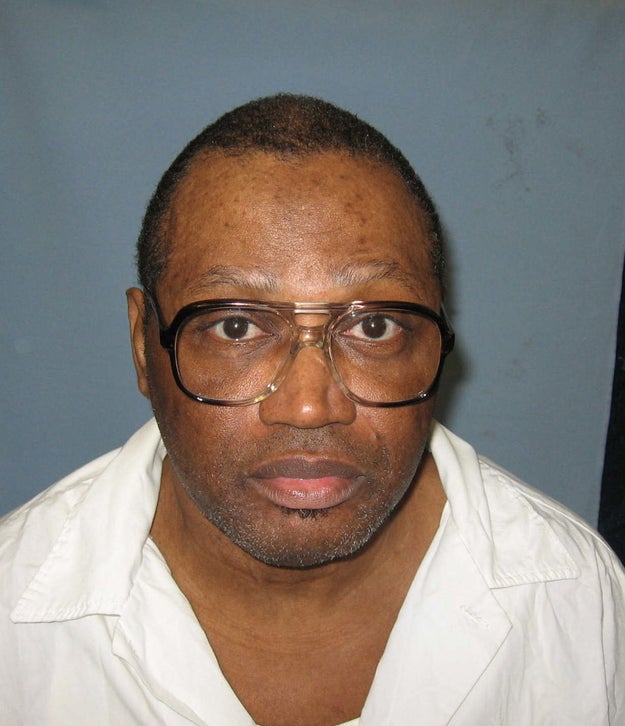
Vernon Madison

Alabama Department of Corrections, via AP, File

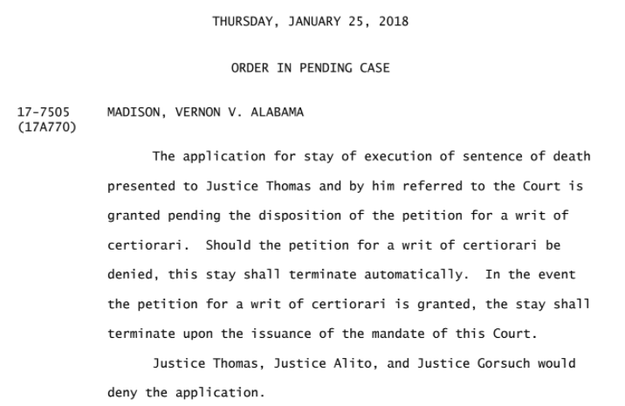
The Supreme Court on Thursday night halted the scheduled execution of Vernon Madison, who was set to face lethal injection in Alabama for the 1985 murder of a police officer.

The stay of execution was granted by the court while the justices consider whether to take up Madison's case in which his lawyers argue he is no longer competent to face execution, noting this he has been diagnosed with vascular dementia and "is unable to recollect the sequence of events from the offense, to his arrest, to his trial and can no longer connect the underlying offense to his punishment." Alabama's lawyers opposed the request.

Justices Clarence Thomas, Samuel Alito, and Neil Gorsuch noted that they would have allowed the execution to proceed. At least five justices had to vote to grant the stay of execution, but justices do not have to announce their vote on stay applications like Madison's stay request, so the exact vote tally — and the votes of the other justices — are not known publicly.

In another petition, also still pending before the Supreme Court, Madison's lawyers argue that putting Madison to death for a death sentence imposed by a judge when the jury had voted to sentence him to life is "arbitrary and capricious" now that the state eliminated the possibility of "judicial override." Alabama also opposes that request.


Source BuzzFeed - Politics http://ift.tt/2GiwIqN

Thursday, January 25, 2018

Be Smart: Mike Allen Wrote The Rules Of Washington And Now Donald Trump's Destroying Them

Mike Allen, co-counder of the media company Axios.

Mike Morgan for BuzzFeed News

It’s 6:20 a.m. on a frigid Friday morning and Mike Allen is sitting in a TV studio overlooking the Capitol, pinpointing — in the parlance of Axios, the short-form news outlet he cofounded — “Why It Matters.”

“Jonathan Swan has a good take,” Allen says, texting with his news protégé as they wait to appear on separate morning shows. “He just texted me, ‘Guarantee you that the Mike Schmidt story” — a piece in the New York Times about the Russia investigation — “was damage control [from] McGahn or Priebus’s lawyer,’” the White House chief counsel and former chief of staff, respectively. Allen texts back that Swan should say this good take when he appears on Morning Joe, but Swan, a 32-year-old Australian who has quickly become a dominant reporter on the White House beat, responds that he won’t because it’s too speculative. “Rare in TV,” Allen says approvingly.

By the order of Allen’s email newsletter, Axios AM, which he has written seven days a week since the company was founded a year ago, the Mike Schmidt story is the third most important thing that busy professionals need to know about this morning. The first two are 1) What’s true and what’s false in Michael Wolff’s explosive book documenting the rolling chaos of Donald Trump’s White House, and 2) How Trump’s threats of legal action, resisted by aides, likely jacked up book sales.

Despite outright falsehoods and violations of off-the-record understandings, Wolff nails two central ideas about the president, Allen writes: “His spot-on portrait of Trump as an emotionally erratic president, and the low opinion of him among some of those serving him.” Allen, who is recognized in Fire and Fury’s acknowledgments for helping make it a “smarter book,” concludes the item with a signature denouement, in keeping with Axios’s ethos of “smart brevity.”

"Every news organization, for better or worse, has been following that model, and it’s because of Mike. Mike brought it to its logical conclusion with Axios.”

Be smart: More than half a dozen of the more skilled White House staff are contemplating imminent departures.”

Allen, at 53, has long been one of the most well-known reporters in Washington. At Politico, the DC news upstart launched in 2007, he fashioned his Playbook newsletter into the rubric for how business got done in Obama’s Washington. Allen, and Politico at large, upended the media ecosystem, covering political maneuvering as a sport for readers in the game itself — Hill staffers, lobbyists, flacks, hacks, and news junkies. Playbook created its own language, which became the language of Washington. People out and about were “SPOTTED,” “SHOTS” were followed by “CHASERS,” and administration talking points produced a “WEST WING MINDMELD.” Allen was the inheritor of a powerful, if mixed, tradition of Washington Inside Dope, one that dates back to Drew Pearson’s syndicated “Washington Merry Go Round” in the 1930s, through to Walter Winchell, Bob Novak, and Mark Halperin. In its prime, Allen’s tipsheet was the most influential “must-read” inside the Beltway. And Allen, who previously worked at the Washington Post and TIME, was dubbed the “man the White House wakes up to” in a 2010 New York Times magazine profile, with Playbook recognized as his “morning distillation of the Nation’s Business in the form of a summer-camp newsletter.”

“Even if you didn't like Politico, you have to acknowledge that it completely changed the game,” said one White House reporter, and not one who works for Politico. “Oh, you have something that moves the ball an inch forward and you can shout that it’s a huge scoop? Publish it. Every news organization, for better or worse, has been following that model, and it’s because of Mike. Mike brought it to its logical conclusion with Axios.”

Axios has bigger ambitions than changing Washington’s news diet. Led by Allen’s fellow Politico alum Jim VandeHei, the company has a broad audience in mind: tens of millions of smart people who seek out quick news on a daily basis. Like Politico, Axios delivers news fast — but distilled down to a few sentences or bullet points. And like Playbook, Axios has created another language, framing the day’s stories under tags like: “Be smart,” “Why it matters,” “Go deeper,” and occasionally the highest praise, “Worthy of your time.” Allen calls these little framing phrases “Axioms,” and they litter Axios’s coverage of politics, media, business, and tech. Rival reporters call them primers for warmed-over conventional wisdom, but if you read Axios consistently enough, you can find yourself texting in Axiosese to friends.

Why It Matters: If they’re mocking you, you’ve done something right.

“This isn’t normal,” Allen wrote this summer. “We should never lose sight that we are experiencing a daily display of unprecedented actions and behaviors.”

Be Smart: Advertisers pay about $75,000 per week to sponsor the Axios AM newsletter, according to a source familiar with the matter.

The short-and-sweet information strategy has helped turn Axios into a well-known “brand” in Washington in no time, and Allen extends this unmatched discipline to real life. When it’s time for his hit on CNBC, Allen’s analysis of Trump’s psyche is essentially a sales pitch for his company. “The president will listen,” he tells the hosts, “if he thinks you’re worthy — axios — and one of the ways that you’re worthy in the president’s eyes is if you’re a successful business person.”

Around Washington, Allen is still known for his Playbook persona, a cheerful insider comfortable with all the swamp politics people claim to hate about Washington. He’s the kind of person who, when you meet him for dinner, has already ordered oysters and shrimp appetizers for the table (which he’s hoping you like, too!). He may even have a gift, like a manuscript of the unreleased Fire and Fury. But at Axios, something seems to have changed about Allen’s way of doing things. A dissonance now appears regularly in his newsletter as the political press trudges through whatever wild thing Trump just said or did. Some days, Allen reports the kind of outrageous things he might not have before, like Sean Spicer threatening to “call the authorities” on him. And some days, Axios AM takes on a sober, moral tone. “This isn’t normal,” Allen wrote this summer. “We should never lose sight that we are experiencing a daily display of unprecedented actions and behaviors.”

To read Axios AM every morning is to watch Allen working out, in real time, what happens when the person who wrote the rules of Washington has to grapple with the person unwriting them.

Axios staff attending an editorial meeting.

Mike Morgan for BuzzFeed News

Between 4:15 a.m. and 5:00 a.m. every morning, Allen and VandeHei settle on the first item for Axios AM. Allen is a master aggregator, reading the big stories in the world of politics, business, and tech so you don’t have to, but the top is almost always some sort of scoop. A new tidbit of information on tax policy, immigration, White House palace intrigue. What people inside the White House think about this or that, why it matters, and how you can be smart about it before the breakfast meeting with your boss. “We might get on the phone and spend upwards a half hour talking,” former Trump campaign adviser Jason Miller said about his chats with Allen. “He would describe it as his ‘getting smart’ time, and he does that with a number of people across the ideological and partisan spectrum.”

Scroll down, and Allen is offering his informed analysis of the biggest stories of the day from outlets like the New York Times, the Washington Post, and others, including Axios. The newsletter is limited to 10 stories, meaning that it is, by design, significantly shorter and breezier than Playbook.

It’s no simple task breaking through in the time of Trump — particularly in the agenda-setting newsletter business — when the president may or may not change the global order with a morning tweet. But Allen is supremely plugged in, and according to two people familiar with the matter, he is among the reporters who the president has spoken to privately (although it’s not clear how recently). An interview with Trump, written by Allen and VandeHei, helped launch Axios into the mainstream days before the inauguration. “They’ve been able to become relevant in Trump's Washington because Mike is Mike,” one White House reporter said.

Much of Axios’s success on the White House beat can also be attributed to Swan, who White House sources say is a fair and well-connected operator. “Mike Allen has got the best insights around town,” Steve Bannon said. “Jonathan has got the best understanding of economic nationalism and the whole economic nationalist part of the White House.”

Swan, a former political reporter for the Sydney Morning Herald, arrived in the US for a program working on the House Foreign Affairs Committee. He used his time on Capitol Hill to network and nab a job at the Hill, the newspaper, distinguishing himself during the 2016 campaign. Swan joined Axios before it had a name, and, bolstered by Allen’s rolodex, quickly became among the “top 5” best-sourced reporters on the White House beat, according to one White House official.

Axios' National political reporter Jonathan Swan on MSNBC's Morning Joe.

MSNBC / Via msnbc.com

Axios launched in tandem with the new administration, so it has helped, with readers and sources, that Axios doesn’t have any prior baggage from 2016. Plus, Allen and Swan, who often go on source meetings together, have a similar metabolism — Allen communicates with hundreds of people 18 hours a day; Swan takes multiple drink and dinner meetings between 6 p.m. and 11 p.m. Competitors like Politico, the New York Times, and the Washington Post all have a handful of reporters covering the White House, but at Axios it’s just Swan and Allen, with assists from VandeHei and other beat reporters when applicable. Their work ethic, and Axios’s speed at getting information online, has made the site a key information hub in the Trump era.

In July, for instance, Swan reported that Anthony Scaramucci would be named White House communications director, and he scooped in May that Trump decided to withdraw from the Paris climate accord. “When I started making calls to the administration — I don’t think people were spinning me — a bunch of senior officials in the administration didn’t know,” a rival White House reporter said about the Paris story. “They were people who should have known before Jonathan.”

"People are not loyal to the president,” Swan said. “If you hustle hard enough you get information.”

Axios’s short-form delivery also means that items often read like interested parties simply dispensed them straight to the publication, a notion Axios disputes. But Allen’s default format — quick, punchy, and a Why It Matters you can help influence — means that the newsletter can be the perfect vessel for getting out information that’s maybe only one piece of the larger story, without the multi-paragraph demolitions you see in much of the press every day. When political operatives and government officials try to tee up exclusive stories for Allen, they say they have to be careful. The advantage of the “mindmeld” style means they can more easily circulate their talking points, but the disadvantage is it can be too obvious where something came from.

"People are not loyal to the president,” Swan says. “If you hustle hard enough you get information.”

It’s in this respect that Allen has been disparaged by competitors and critics for trafficking in “access journalism,” the symbiotic relationship between the powerful and the media whereby exclusives are doled out to safe spaces. There’s even a joke in the White House press corps, where Allen is regarded as a suck-up, that “Axios” means “access” in Greek. (“It’s Greek for worthy, dude,” Allen responds.)

“It is no secret we have lots of access to people in power in Washington, business, tech, and media,” VandeHei said in a statement. “It’s dumb — and often the lament of journalists with no sources or access to news — to simply say access is bad. The question is: What do you do with it? And Mike and all of Axios use our insight, connections, sources to bluntly illuminate what’s really happening with the people and topics that matter.”

Regardless, the result is that the newsletter can take on a parlor game quality, where the reader guesses which part of the White House, or media, or political party, might want to plant a piece of information. Like in the case of Michael Wolff. As more incendiary anecdotes and quotes emerged in the press, Wolff began to face pressure not just from the White House, but from a media chattering class that has long loathed him. The backlash was on. How could Wolff’s book paint such a detailed picture, media types wondered aloud, of a private dinner between Bannon and the late Fox News chief Roger Ailes? Axios AM provided the opportunity for Wolff’s answer. “It turns out Wolff hosted the dinner for six at his Manhattan townhouse,” Allen scooped.

Bannon played defense in the same Axios AM item. He “wouldn't comment on the record,” Allen wrote, “but ‘a source with knowledge of this matter’ texted me that ‘more than a dozen wh staffers or colleagues of potus talked with [wolff] ... because the wh was cooperating with the book.’”

Bannon is a well-known master of the background quote, and a savvy political reader can tell when a source familiar or a source close to the situation… is the principal himself. But placing “source with knowledge of this matter” within quotation marks, as Allen did, reflects the dissonance permeating Axios AM since the beginning of the administration. Would Allen have made that rule-bending wink pre-Trump? When asked about the characterization, Allen smiles, then pauses. “And, it’s a salute to the intelligence of our readers,” he says. “Our readers get it. Like, they know.”

Axios staff at work in their newsroom.

Mike Morgan for BuzzFeed News

Axios argues that Allen is often a tough critic of the White House, with frequent newsletter reminders that we are not living in normal times and nuclear war with North Korea remains a legitimate possibility. “So much of the Trump coverage is what I call the NASCAR effect,” Allen says. “People just want to see the flaming tires and the bent metal. And our idea is, no, there’s enough noise, we’re going to try to eliminate it. To explain it. To take both sides. To take people who know the president best and explain how he makes decisions.”

The access jab has become a favorite gripe from the political left, and a certain style of reporting on the inner workings of the administration often faces denunciation as “normalizing” Team Trump’s behavior and distancing the reader from policy ramifications. VandeHei fought this notion when he appeared on Pod Save America, the progressive podcast hosted by former Obama officials and a vanguard of Resistance Twitter.

“As Trump was pulling out of Paris, Jonathan Swan — who again is a great reporter — covers it by saying, ‘Why does this matter?” Jon Lovett, a former Obama speechwriter, said on the podcast. “‘Well, it matters because he’s undoing Obama’s proposal. It’s a win for Trump. It’s a defeat for Democrats.’ But of course why it matters is how it actually affects the planet. Do you not see any problem in the assumption that being smart means you already know the consequences? That the consequences aren’t important enough to be mentioned in the coverage of the politics?”

VandeHei fought back. “Could you take a Be Smart and do 20 different versions of it? Absolutely,” he responded. “Are we always going to get it right when we say Why It Matters or Be Smart or what you should think about next? No, we’re not always going to satisfy you. But you have to look at it in totality. Do you walk away better educated, better informed, and better equipped to make better decisions because of the content we’re providing? If you answer yes, you will read it.”

“The reality is that what Politico did and what Twitter has done has made political journalism very fast and small.”


Source BuzzFeed - Politics http://ift.tt/2E7tgOW