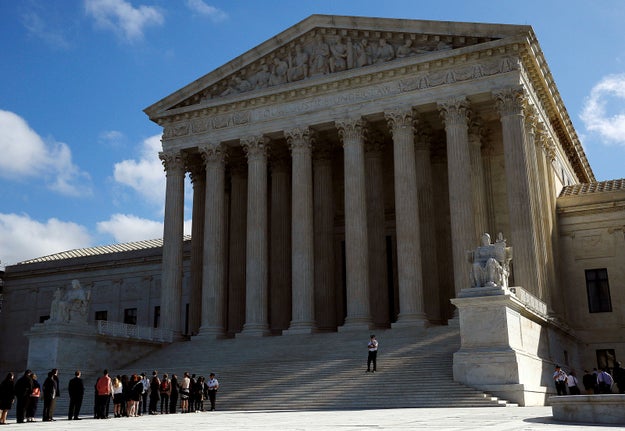
Gary Cameron / Reuters
Merrick Garland will not be on the Supreme Court.
With Donald Trump's election, the leftward shift of the American legal landscape has been halted in its tracks.
Earlier this year, as liberals had prepared for a progressive majority on the high court for the first time in generations, Donald Trump proposed a list of 21 names for his potential picks for Supreme Court vacancies.
Now, with Trump's election, it is his vision — with a Republican-led Senate — that will control what comes next for the federal judiciary.
Trump's list of possible judicial nominees included some — like 7th Circuit Court of Appeals Judge Diane Sykes — who would have been on any Republican candidate's Supreme Court shortlist.
But the list also included some — like Texas Supreme Court Justice Don Willett, with a well-known Twitter account — who could dramatically alter the style and spirit of the court.
Now, in addition to putting together an administration, Trump also will have to decide how he is going to make his first mark on the Supreme Court.
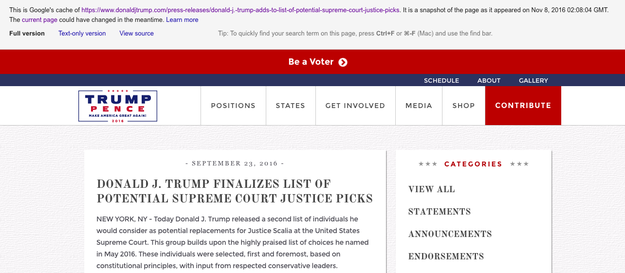
A Google-cached version of the Trump campaign's potential Supreme Court justice picks news release.
Via webcache.googleusercontent.com
Trump does not, of course, need to keep to the list. In fact, the news release announcing the completion of the 21-member list was removed from the Trump campaign website sometime after Monday evening. The original news release of 11 names was also removed from the campaign website sometime after Sunday morning. [Update: It appears that all news releases from the campaign — including, for example, Trump's December 2015 call for a ban on Muslim immigration — were removed from the website in recent days. This could have been the result of a technical issue with the site that was being exploited.]
The Senate could potentially give Trump even greater control over the future of the courts, as well.
The filibuster — long used as a procedural hurdle to allow the opposition party some control over preventing the most extreme of nominations by requiring 60 votes to end debate on an issue — was diminished in 2013, when Democrats ended it as a requirement for lower-court judicial nominees. Earlier this year, Sen. Lindsey Graham said that it was likely that the filibuster would, eventually, be ended as to Supreme Court nominees as well.
"There'll come a day when you have a Republican or Democratic president with a Republican or Democratic Senate, and they’re going to change the rules on the Supreme Court," he said in March.
Come Jan. 20, 2017, there will be a Republican president with a Republican Senate. If Democrats don't allow an up-or-down vote on the nominee Trump puts forward, expect Graham's warning — which he presumed at the time was a warning to Republicans — to become a reality.
After all of that, though, filling the vacancy left by Antonin Scalia's death with a conservative will not change the balance of the court on most high-profile ideological disputes. But Tuesday's elections stop the leftward shift.
Once Scalia's seat is filled, Chief Justice John Roberts will regain control of a marginally functional majority on the court — with Justice Anthony Kennedy serving, yet again, as the key vote on a number of cases.
The future of the court — a potential long-term conservative resurgence — will, ultimately, depend on what happens after that and whether Trump also gets to name a successor to a justice on the left side of the court's bench.
If that happens, which is entirely possible given the ages of the justices, then the progressive possibility could become a conservative, long-term reality.
Source BuzzFeed - Politics https://www.buzzfeed.com/chrisgeidner/the-election-changed-the-politics-of-the-supreme-court?utm_term=4ldqpia
0 comments:
Post a Comment